
PSA, TSA, membrane and cryogenic hydrogen purification compared
The four hydrogen purification technologies differ most in the purity they reach, the hydrogen they lose and the feeds they tolerate. The figures in this table are typical published ranges for orientation. They are not guarantees, and any of them can be moved by design.
| Criterion | Pressure swing adsorption (PSA) | Temperature swing adsorption (TSA) | Membrane | Cryogenic |
|---|---|---|---|---|
| What it removes | Bulk impurities: carbon dioxide, methane, carbon monoxide, nitrogen, water | Trace, strongly adsorbed impurities: water above all; with a deoxidiser upstream, oxygen | Slower-permeating gases: methane, nitrogen, carbon monoxide | Higher-boiling components: hydrocarbons, carbon monoxide, nitrogen |
| Typical product purity | 99.9 to 99.999 mol% | Raises already pure hydrogen, for example from 99.9 to 99.999 mol% | 90 to 98 mol% | 90 to 98 mol% |
| Typical hydrogen recovery | 70 to 90 % | Very high; losses limited to regeneration gas that is not recycled | 85 to 95 %, falling as purity rises | 90 to 98 % |
| Feed tolerance | Wide range of compositions; must be free of liquids; heavy hydrocarbons and chlorides damage adsorbent | Low impurity levels only; bed is sized on impurity load | Needs liquid-free, pre-treated gas; sensitive to condensation and some contaminants | Needs thorough pre-treatment: water and carbon dioxide would freeze |
| Product pressure | Close to feed pressure | Close to feed pressure | Low: hydrogen is the permeate | Close to feed pressure |
| Turndown | Good; cycle time adjusts to flow, typically down to about 30 % | Very good; cycle simply lengthens | Very good; modules are switched in and out | Limited |
| Footprint | Moderate; several vessels and a valve skid | Small to moderate; two or three vessels and a heater | Small and light | Large; cold box |
| Capital and operating cost character | Moderate capital; low operating cost; tail gas must have a use as fuel | Low to moderate capital; regeneration heat is the main operating cost | Low capital; recompression of product is the main operating cost | High capital; economic at large scale, or where by-products have value |
| Best-fit use case | High-purity hydrogen from reformer syngas or refinery off-gas | Gas drying; final clean-up of electrolyser hydrogen in a DeOxo dryer package | Bulk hydrogen recovery or ratio adjustment where moderate purity is enough | Very large streams with valuable hydrocarbon by-products |
How to choose a hydrogen purification technology
The choice of hydrogen purification technology follows from three questions asked in order. First, what is in the feed, and at what level: percent or parts per million? Second, what purity and which named impurity limits does the user need? Third, what happens to the rejected gas? A PSA needs somewhere to burn its tail gas. A membrane needs a use for its high-pressure residue. A TSA needs a source of heat and somewhere to send wet regeneration gas.
Technologies are also combined. A membrane or cryogenic unit can do bulk recovery ahead of a PSA. A TSA dryer can protect a downstream process. We design and manufacture the PSA and TSA parts of such schemes; we do not supply membranes or cold boxes, and we say so when one of them is the better answer.
Hydrogen purification packages we design and manufacture
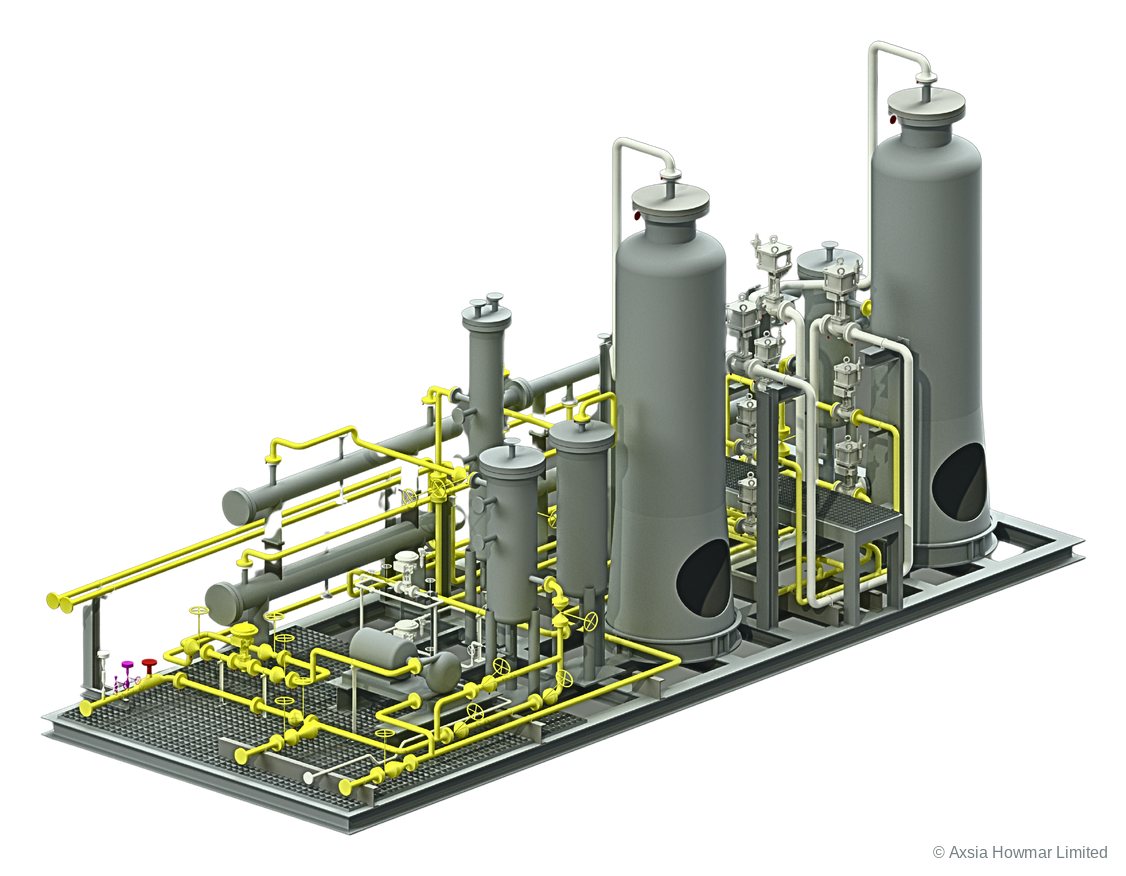
Axsia Howmar designs hydrogen purification systems from a process datasheet, procures the key components, manufactures the package through an approved and audited fabricator under its own project management and supervision, delivers it to site, commissions it and hands it over. The two package types are:
- PSA hydrogen purification, for bulk purification to 99.9 mol% and above.
- TSA hydrogen purification, for gas dehydration and for DeOxo dryer packages on electrolyser hydrogen.
Common operating problems in hydrogen purification units
The common operating problems in hydrogen purification units are falling product purity, falling recovery, rising bed pressure drop and shortened adsorbent life. In PSA units the usual root causes are liquid or heavy hydrocarbon carry-over into the beds, leaking or slow switching valves, and a cycle that no longer matches the feed. The troubleshooting symptom index covers each.