
Hydrogen purification

Hydrogen dryer for electrolyser hydrogen

A hydrogen dryer takes wet hydrogen from an electrolyser, which also contains a little oxygen, and delivers dry, oxygen-free hydrogen. A catalytic DeOxo reactor converts the oxygen to water, and a temperature swing adsorption (TSA) dryer then removes the water on molecular sieve. Axsia Howmar designs the package and selects the regeneration scheme on operating cost.

Capacity range, from small pilot units to a 100 MW electrolyser
50 to 20,000 Nm³/h
Oxygen and water in the product, purity up to 99.999 %
Below 5 ppm
Closed-loop regeneration in both the dry-gas and wet-gas layouts
Zero hydrogen loss

Send a technical enquiry

How it works: Hydrogen dryer for electrolyser hydrogen

  1. Feed pre-heat

    Wet hydrogen from the electrolyser is warmed so that no liquid water reaches the catalyst.

  2. Catalytic oxygen removal

    In the DeOxo reactor, oxygen reacts with hydrogen over a catalyst to form water. The reaction releases heat.

  3. Cooling and water knock-out

    A trim cooler condenses most of the water, and a knock-out drum removes it.

  4. Adsorption

    The hydrogen flows through a molecular sieve bed, which adsorbs the remaining water. Dry hydrogen leaves the bed.

  5. Regeneration of the second bed

    While one bed adsorbs, hot gas flows through the other bed and drives the water off. An electric heater supplies the heat.

  6. Cool-down and changeover

    The heater switches off, the regenerated bed is cooled at a controlled rate, and the two beds exchange duties automatically.

The package

DeOxo reactor and two-bed TSA dryer on one skid

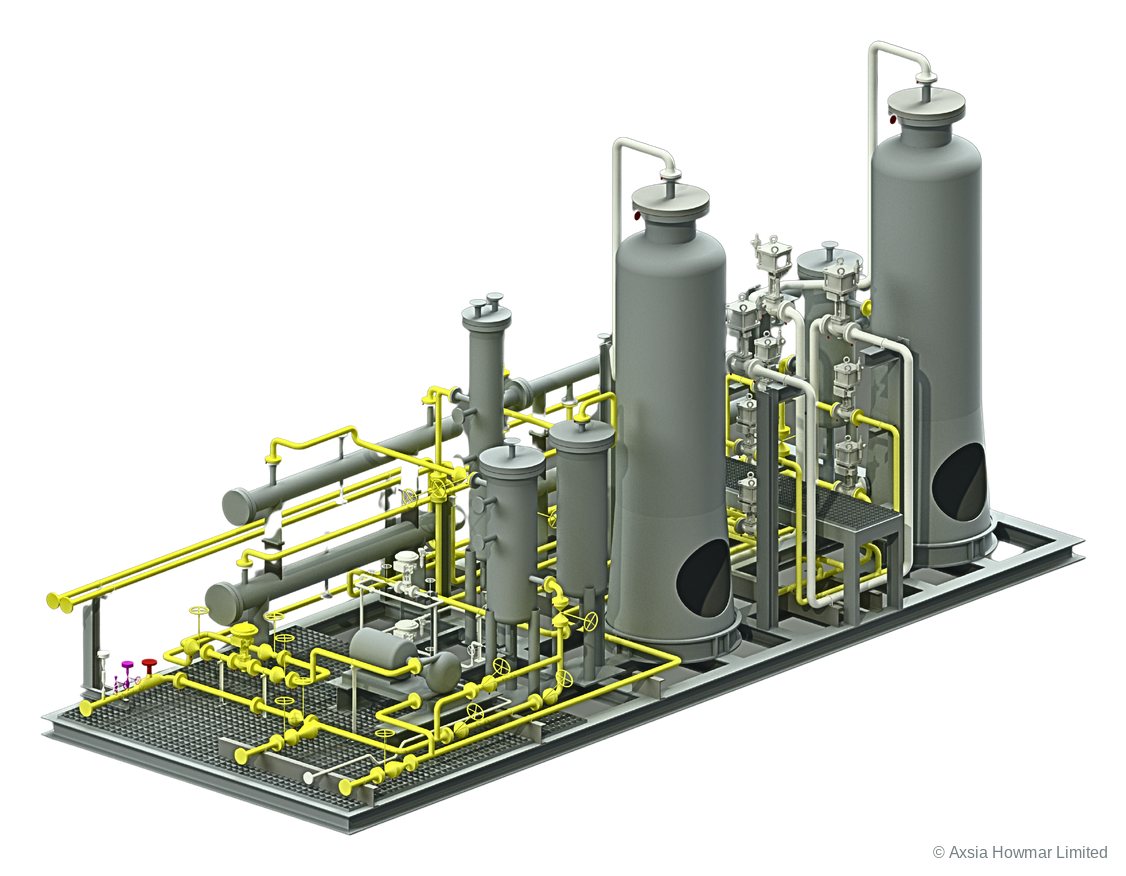
The DeOxo TSA dryer combines a catalytic deoxygenation reactor with a two-bed molecular-sieve temperature swing adsorption dryer in one compact, skid-mounted package. It is built for hydrogen from water electrolysis: it converts the residual oxygen and removes the moisture, taking both below 5 ppm and delivering purity of up to 99.999 %.

Feed passes through pre-filter F-1, which removes solid and liquid particulates, and is warmed in heater H-1 to the catalyst inlet temperature, typically about 70 °C. In the DeOxo reactor R1 a precious-metal catalyst promotes the exothermic reaction of oxygen with hydrogen. The hot effluent is cooled in C-1 and the condensed water drained from knock-out drum KD-1. The saturated gas then enters the on-line adsorber, where molecular sieve takes out the remaining moisture at near-ambient temperature, and the dry product leaves through dust filter F-2. Capacities run from 50 to 20,000 Nm³/h, for new green-hydrogen plants and for integration into existing facilities.

3D model of a DeOxo TSA dryer skid: reactor, twin adsorbers, coolers, knock-out drums, heaters and filters with interconnecting piping on one frame.

Dry-gas regeneration

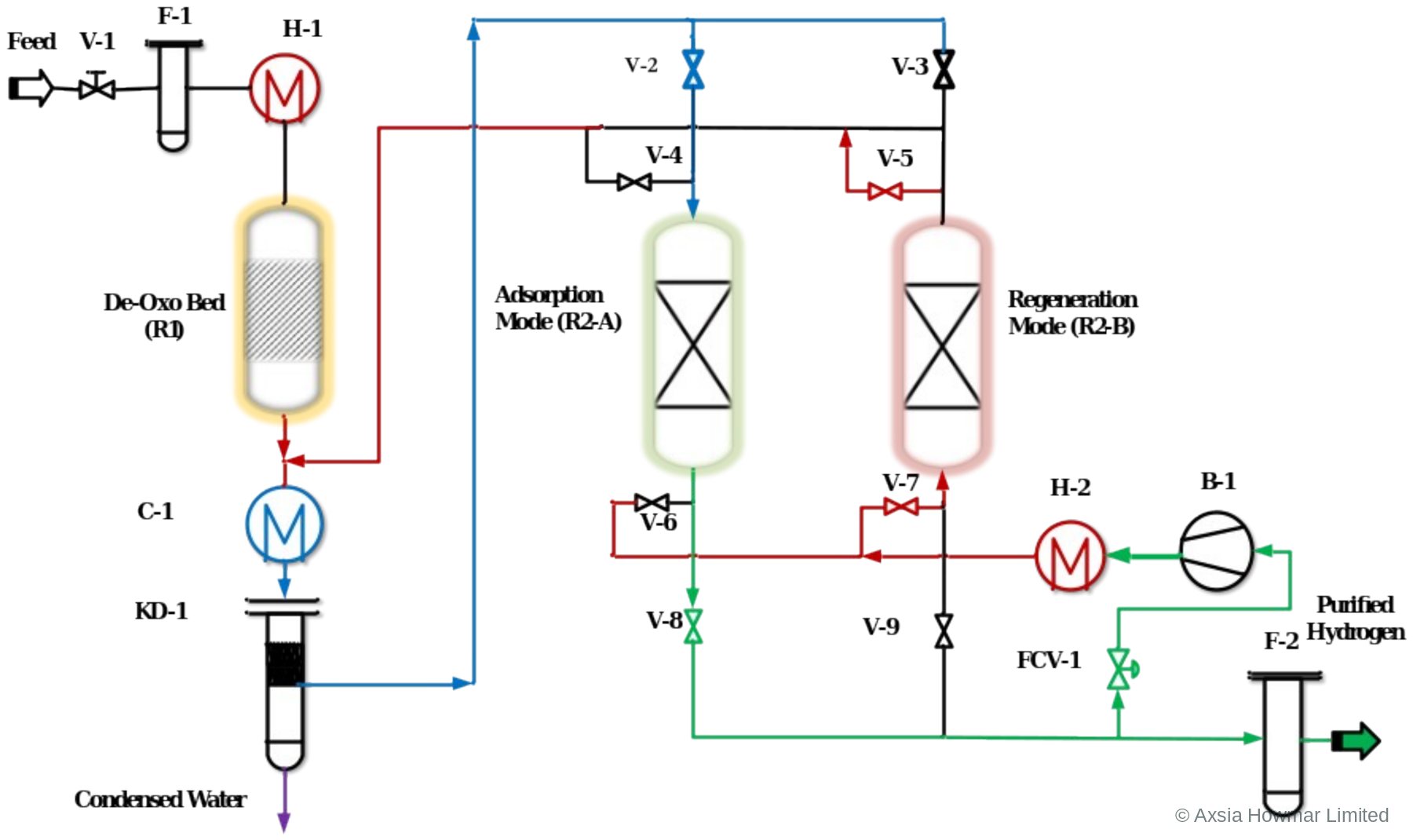
Dry-gas regeneration: a slipstream of dry product, driven by a blower

While one bed adsorbs, the other is regenerated with gas flowing counter-current to adsorption in three steps: heating, in which hot hydrogen desorbs the water; cooling, in which unheated gas returns the bed to adsorption temperature; and standby until changeover. Both regeneration layouts share the same front end and both are closed loops with zero hydrogen loss. They differ only in where the regeneration gas is drawn from and what drives it round the loop.

In the dry-gas layout the regeneration gas is a slipstream of dry product hydrogen drawn downstream of the on-line adsorber. Recycle blower B-1 drives the loop, with the flow set by FCV-1, and the gas is heated in H-2 before it enters the bed. The water-laden gas rejoins the DeOxo effluent upstream of C-1 and KD-1, so a single cooler and knock-out drum serve the whole unit. Dry regeneration gas leaves a very low residual loading and a high working capacity, but because the recycled gas passes through the on-line adsorber again, the adsorbers are sized for the feed plus the regeneration flow.

Process flow of the DeOxo TSA dryer with dry-gas regeneration. Wet hydrogen in blue, hot regeneration gas in red, dry product in green, condensed water in purple.

Wet-gas regeneration

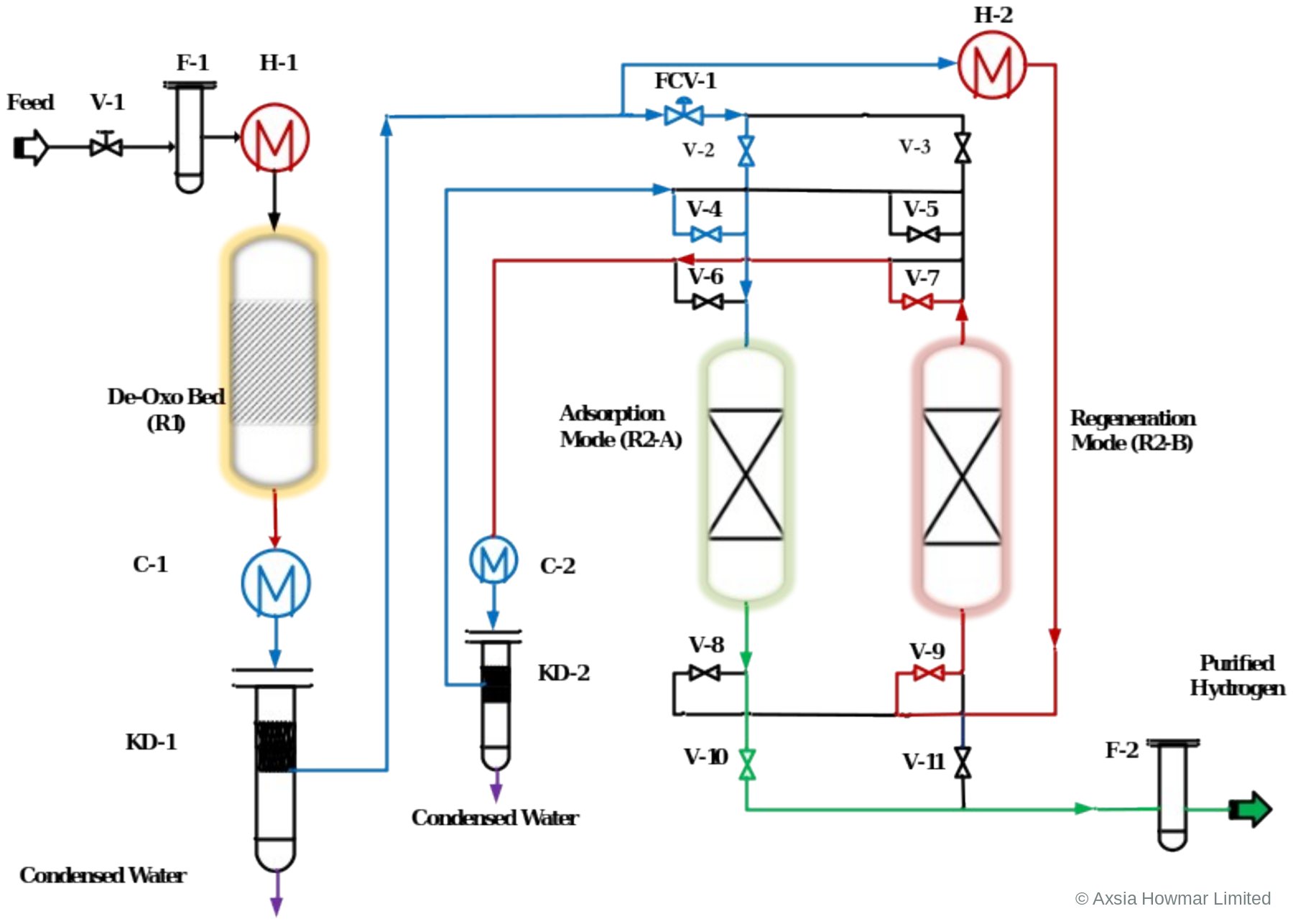
Wet-gas regeneration: a feed slipstream, no blower

In the wet-gas layout the regeneration gas is a slipstream of the saturated gas leaving KD-1, drawn upstream of the adsorbers. The pressure drop across FCV-1 in the main line drives the slipstream through heater H-2 and the bed, so no blower is needed. The spent gas is cooled in C-2, its water removed in KD-2, and it rejoins the feed to the on-line adsorber.

The adsorbers handle only the feed flow, which keeps them smaller. Because the regeneration gas carries its own moisture, the bed retains a higher residual loading and has a lower working capacity. Axsia Howmar selects the layout for each project from the feed conditions, oxygen range, turndown and site constraints.

Process flow of the DeOxo TSA dryer with wet-gas regeneration: the slipstream is taken ahead of the adsorbers and driven by the main-line pressure drop.

Regeneration and retrocondensation

Regeneration is the most demanding step of the cycle

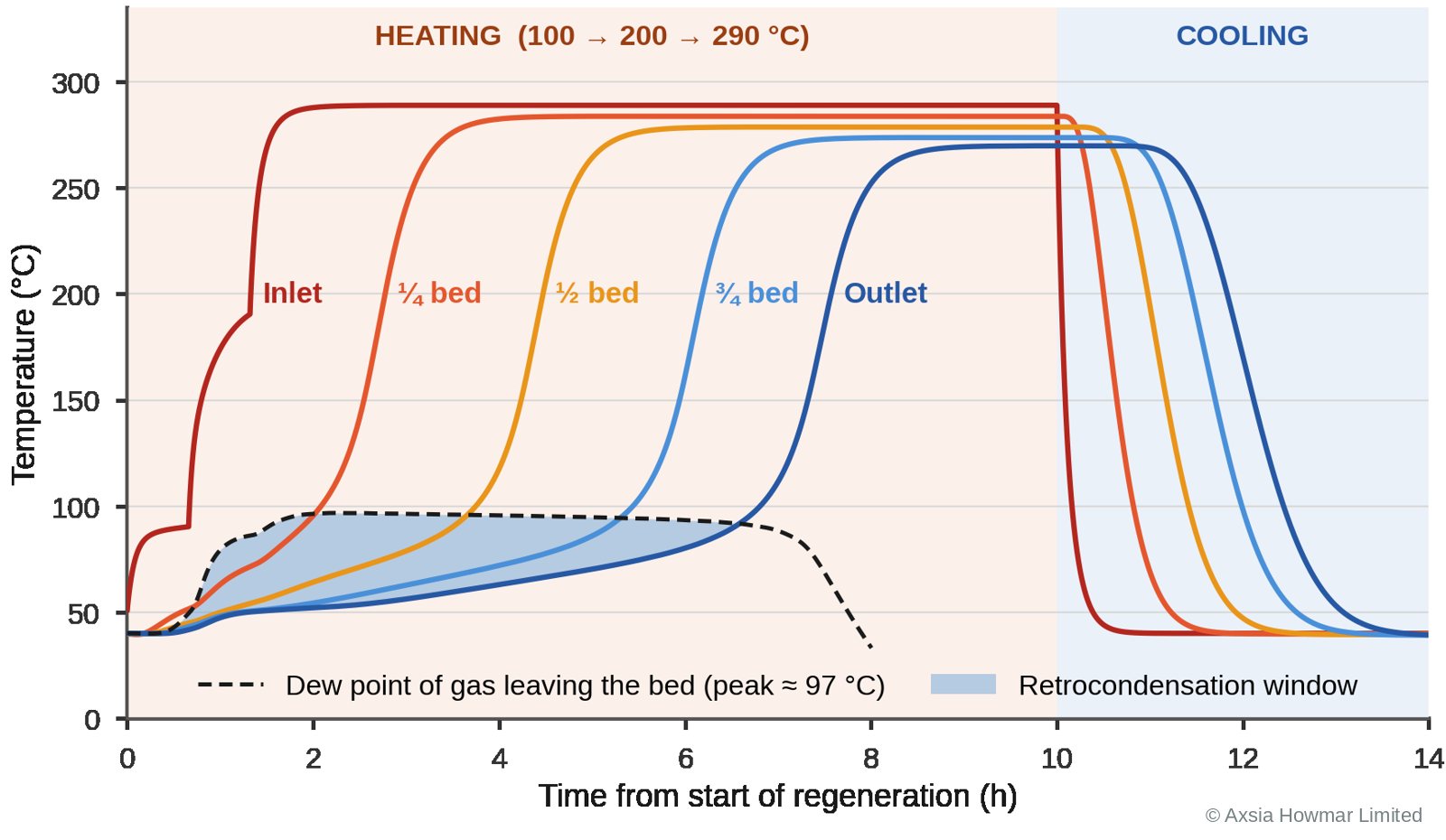
Hot gas enters the loaded bed at the product end, and a heat front travels towards the feed end, where most of the water is held. The chart shows a dynamic simulation of a bed sized for a 100 MW electrolyser, about 20,000 Nm³/h, regenerated with dry gas at about 15 barg using a staged 100, 200 and 290 °C heating programme, followed by cooling.

Water desorbed behind the heat front is swept into the still-cold part of the bed. At about 15 barg the gas leaving the bed carries up to 5.7 mol% water, giving it a dew point of about 97 °C, while the outlet end of the bed warms only slowly, from about 45 to 80 °C, over roughly six hours. Wherever the bed is colder than the gas dew point, water condenses back into the adsorbent. Repeated every cycle, this exposure to hot liquid water weakens the binder, causes caking and dusting, erodes capacity and shortens adsorbent life.

Axsia Howmar uses dynamic simulation to set the heating ramps, regeneration-gas ratio and step times, keeping this retrocondensation window short and making sure the bed is fully dried and cooled before it returns on line.

Simulated gas temperature at five depths, from the regeneration-gas inlet at the product end to the outlet at the feed end. Dashed line: dew point of the gas leaving the bed. Shaded area: retrocondensation window.

Cost of ownership

A dryer that is cheap to build is not necessarily cheap to own

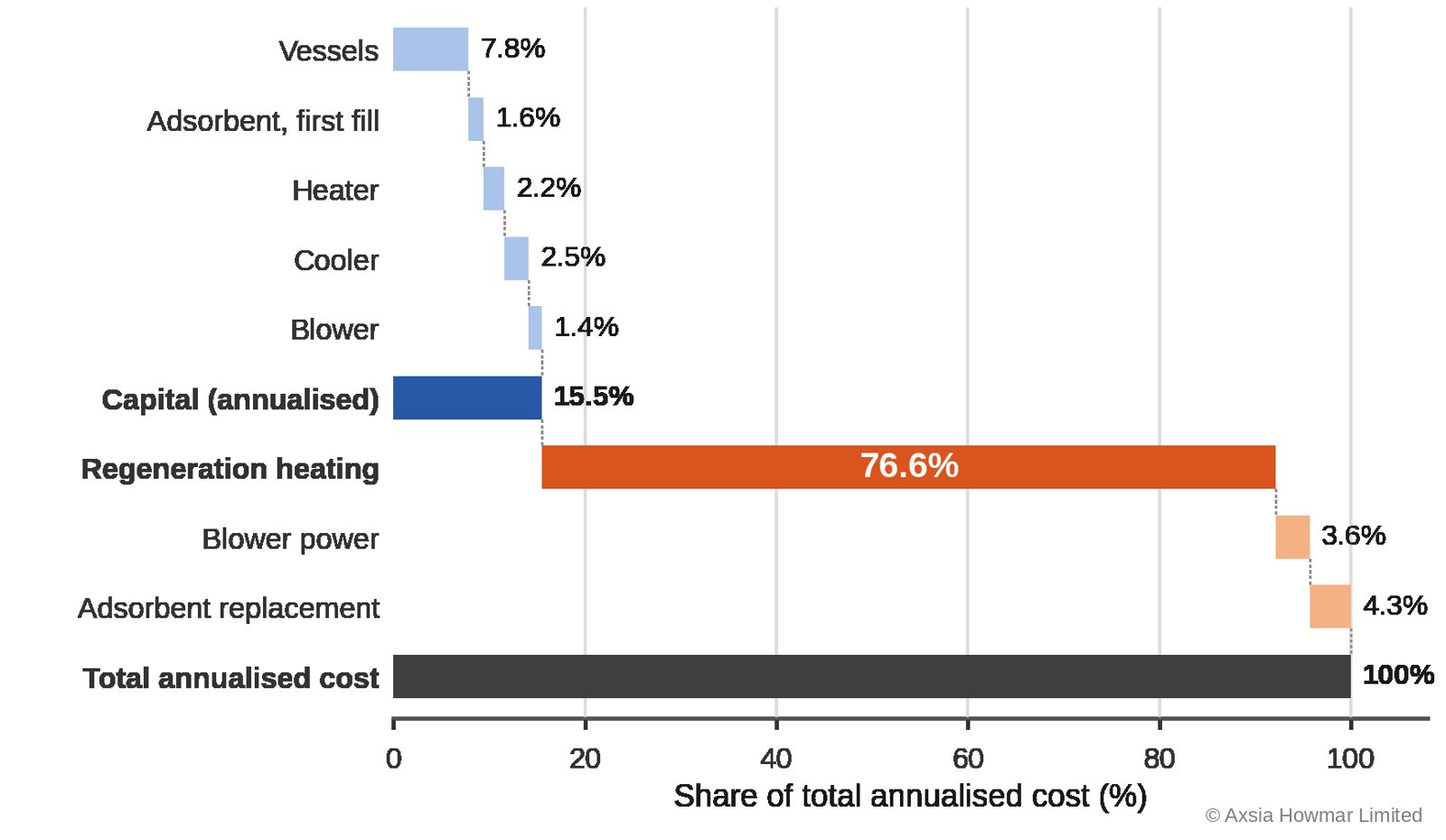
Once the capital cost is annualised over the plant life and added to the running costs, the equipment and the first adsorbent charge account for only about one-sixth of the total annualised cost of a cost-optimised DeOxo TSA dryer. The heating step dominates: the electricity used in every cycle to heat the adsorbent, the vessel and the regeneration gas to about 290 °C makes up more than three-quarters of the total, or about 90 % of the operating cost. Axsia Howmar therefore designs for the lowest total annualised cost, not the lowest capital cost.

The DeOxo reaction is exothermic: the effluent leaves the reactor about 160 °C hotter for every 1 vol% of oxygen in the feed, and in a conventional layout this heat is simply rejected in cooler C-1. Our recuperator option is a gas-gas heat exchanger between the reactor R1 and C-1. It transfers the reaction heat to the regeneration gas ahead of heater H-2, so the electric heater only has to top the gas up to regeneration temperature. It fits at the same point in both layouts, sized for the highest expected oxygen content while the heater is sized for the lowest, so full regeneration temperature is reached across the electrolyser operating range.

Share of total annualised cost for a cost-optimised design without heat recovery, for a 20 MW electrolyser at 0.5 vol% oxygen. Capital annualised over the plant life; unit rates are site-specific.

Proven at pilot scale

Design methods validated on a hydrogen drying pilot plant

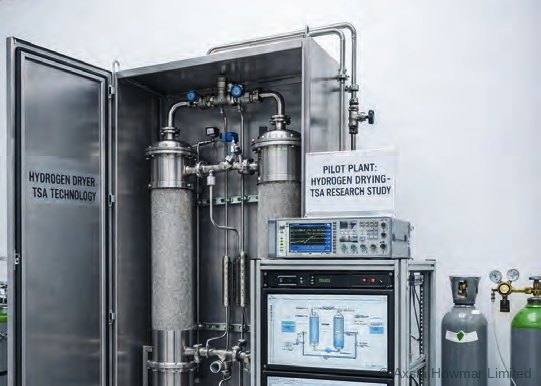
The cycle models, adsorbent behaviour and regeneration programmes behind each proposal have been checked against measurements on a TSA hydrogen drying pilot system, so the heaters, coolers and blowers in a full-scale package are sized on calculated transients that have been seen in practice.

TSA hydrogen drying pilot system used for the research study behind the design method.

Where the hydrogen dryer sits in the process

The hydrogen dryer sits directly downstream of the electrolyser and its gas-liquid separator, and upstream of compression, storage or the user. It is the purification step for electrolyser hydrogen in the same way that pressure swing adsorption is for reformer hydrogen. The two are not interchangeable: see PSA vs TSA for hydrogen purification. The adsorption principle is explained on the TSA hydrogen purification page.

Designing for operating cost

The electric regeneration heater, not the vessels, dominates the lifetime cost of drying electrolyser hydrogen. Axsia Howmar therefore designs the package around its energy use. Three measures are considered from the first flowsheet:

  • Heat recovery from the DeOxo reactor. A gas-gas recuperator transfers the heat released in the DeOxo reactor into the regeneration stream ahead of the electric heater. The effluent leaves the reactor about 160 °C hotter for every 1 vol% of oxygen in the feed, so the saving on a given project depends on the feed oxygen content and the cycle design.
  • Dry purge. With dry product gas as the purge, water begins to leave the molecular sieve at about 43 °C, so the heater does useful work from the start of the ramp. % of design flow |
  • Selection on your criterion. The candidate schemes are compared on one basis and ranked by installed cost, annual operating cost or total annualised cost, whichever the client chooses.

Further measures are a cool-down rate that uses no more purge than the thermal-shock limits of the adsorbent and vessel wall require, two-bed or three-bed arrangements that reduce vessel size, and an electric heater sized on the calculated transient peak.

Four regeneration schemes compared on one basis

SchemeHow it worksWhere it fits
Wet regeneration with recuperatorSlipstream of saturated feed, no blower; DeOxo heat recovered into the regeneration gasLowest heater duty of the wet schemes
Dry regeneration with recuperatorDry product recycle purge with blower; DeOxo heat recoveredLowest dew points together with heat recovery
Wet regeneration, no recuperatorPressure-driven feed slipstream; fewest exchangersSmall duties and short delivery
Dry regeneration, no recuperatorClosed product recycle loop with blowerWhere margin on the product specification matters most

How the design is calculated

Each proposal is supported by a design calculation that the client’s engineers can review.

  • Time-resolved regeneration. A packed-bed transient model follows the thermal front through heating, soak and controlled cool-down, so heaters, coolers and blowers are sized on calculated peaks and not on cycle averages.
  • Adsorption equilibria. Isotherms fitted to the adsorbent supplier’s data set the desorption temperature window, the energy demand and the residual water loading.
  • Flow and integrity checks. Plug flow is checked through axial dispersion, pressure drop is calculated at hot and cold conditions, and thermal-shock limits for the adsorbent and the vessel wall are applied to every candidate design.

What is delivered with each package

  • Process design basis with a time-resolved cycle model.
  • Comparison of the four regeneration schemes on one basis.
  • Mass balance for every stream, with pressures.
  • Heat exchanger datasheets sized on calculated peak duties.
  • Control and safeguarding narrative, with line and valve sizing.
  • Thermal-shock check for adsorbent and vessel wall.
  • A skid-mounted package, tested at the fabricator’s workshop before delivery.

Materials and adsorbent

Vessels and piping in dry hydrogen service are normally carbon steel or stainless steel to the project piping specification, with hydrogen service requirements applied. The dryer uses molecular sieve beads selected for water capacity and resistance to repeated thermal cycling.

Talk to an engineer about your unit

Tell us the equipment, the duty and what you are seeing. Partial data is normal: send what you have and we will tell you what else matters. We acknowledge every enquiry within 1 working day.

Design parameters: Hydrogen dryer for electrolyser hydrogen

Design parameters: Hydrogen dryer for electrolyser hydrogen
ParameterTypical rangeUnitBasis / note
Plant sizeUp to 100MW electrolyserRoughly 0.25 MW to 100 MW of electrolyser
Feed hydrogenAbout 99.7, saturated with watermol%Typical electrolyser outlet, with oxygen present
Feed oxygen500 to 2,000ppm by volumeElectrolyser dependent
Operating pressure10 to 30bargGauge pressure
TurndownTo 30% of design flow% of design flow |
Bed configurationTwo beds (1+1) or three beds (2+1, staggered)Automatic changeover
AdsorbentMolecular sieve beads, 1.6 to 2.5mmTwo beds, one on line while the other regenerates
RegenerationElectric heating, up to 290°CWet feed slipstream or dry product recycle

Typical ranges for orientation only. The design basis for each unit is set from the feed analysis and the required product specification.

Performance we design to: Hydrogen dryer for electrolyser hydrogen

Performance we design to: Hydrogen dryer for electrolyser hydrogen
MetricValue or rangeUnitConditions / design basis
Product hydrogen purity99.9 to 99.999mol%Typical design range, set per project. % of design flow |
Product oxygenBelow 5ppm by volumeTypical design value. % of design flow |
Product water dew point-60 or lower°CTypical design value; state the pressure at which the dew point is measured. % of design flow |
Hydrogen recoveryAbove 99%Typical design value; depends on regeneration scheme. % of design flow |
Regeneration energy with heat recoveryAbout 22 lower%Staged heating programme, then cooling with unheated gas

Achievable performance depends on feed conditions and the agreed design basis. These figures are design targets, not guarantees independent of those conditions.

Codes and standards applied to Hydrogen dryer for electrolyser hydrogen

Typically applied; the governing codes are confirmed per project with the client and the jurisdiction.

ASME BPVC Section VIII Division 1
Pressure vessels Reactor and adsorber vessels, where specified
PD 5500 / EN 13445
Unfired pressure vessels Where a UK or European code is specified
TEMA
Shell and tube heat exchangers Coolers and gas-gas recuperator, where applicable
IEC 60079 / ATEX / IECEx
Equipment for explosive atmospheres Electric heater, instruments, junction boxes
ISO 14687
Hydrogen fuel quality Where the product specification refers to it
PED / UKCA / UKEX
Conformity marking Where the installation jurisdiction requires it

Applications: Hydrogen dryer for electrolyser hydrogen

  • Hydrogen for fuel cells and mobility: Meeting a fuel-quality specification for oxygen and water downstream of an alkaline or proton exchange membrane (PEM) electrolyser.
  • Hydrogen for industrial users: Drying and deoxygenating electrolyser hydrogen ahead of compression, storage or pipeline injection.
  • Hydrogen for synthesis: Protecting downstream catalysts from oxygen and water in ammonia, methanol and e-fuel plants.

Scope of supply: Hydrogen dryer for electrolyser hydrogen

  • Process design basis (Time-resolved cycle model, mass balance for every stream, and comparison of regeneration schemes on one basis)
  • DeOxo reactor with catalyst, feed pre-heater, trim cooler and knock-out drum
  • Adsorber vessels with molecular sieve, switching valves and regeneration heater
  • Gas-gas recuperator and regeneration blower (Where the selected scheme uses them)
  • Heat exchanger datasheets, control narrative, line and valve sizing
  • Skid-mounted package with instrumentation and control panel (Fabricated and tested by an approved and audited fabricator under our supervision)
  • Commissioning, start-up support and operator training

Frequently asked questions: Hydrogen dryer for electrolyser hydrogen

Why does electrolyser hydrogen need a dryer?

Electrolyser hydrogen needs a dryer because it leaves the electrolyser saturated with water and containing a small amount of oxygen that has crossed from the oxygen side. Fuel cells, compressors, storage and most chemical users need hydrogen that is dry and almost free of oxygen, so both must be removed.

What does the DeOxo reactor do?

The DeOxo reactor removes oxygen by reacting it with a little of the hydrogen over a catalyst to form water. The reaction is exothermic, so the gas leaves hotter than it entered. The water made in the reactor, together with the water already in the feed, is then removed by cooling and by the TSA dryer.

What dominates the operating cost of a hydrogen dryer?

The operating cost of a hydrogen dryer is dominated by the electricity used by the regeneration heater. Over the life of the plant this normally outweighs the cost of the vessels. The regeneration scheme, the heat recovered from the DeOxo reactor and the way the heater is sized therefore matter more than small savings in equipment.

What is the difference between wet and dry regeneration?

Wet regeneration heats the bed with a slipstream of the saturated feed, which needs no blower and is simple. Dry regeneration recycles dry product gas through the bed with a blower, so water starts to leave the molecular sieve at a lower temperature and lower product dew points can be reached.

What information is needed for a first design?

For a first design of a hydrogen dryer we need the hydrogen flow rate and its range, the pressure and temperature at the battery limit, the oxygen content of the feed, and the product specification for oxygen and water. The electrolyser datasheet usually contains all of these.

Talk to an engineer about your unit

Tell us the equipment, the duty and what you are seeing. Partial data is normal: send what you have and we will tell you what else matters. We acknowledge every enquiry within 1 working day.