
Market commentary, not advice. Figures are taken from the public sources listed at the end and are correct as of the dates given; the situation is moving and some will have changed by the time you read this. Nothing here is a forecast of prices or a recommendation to trade.
What happened
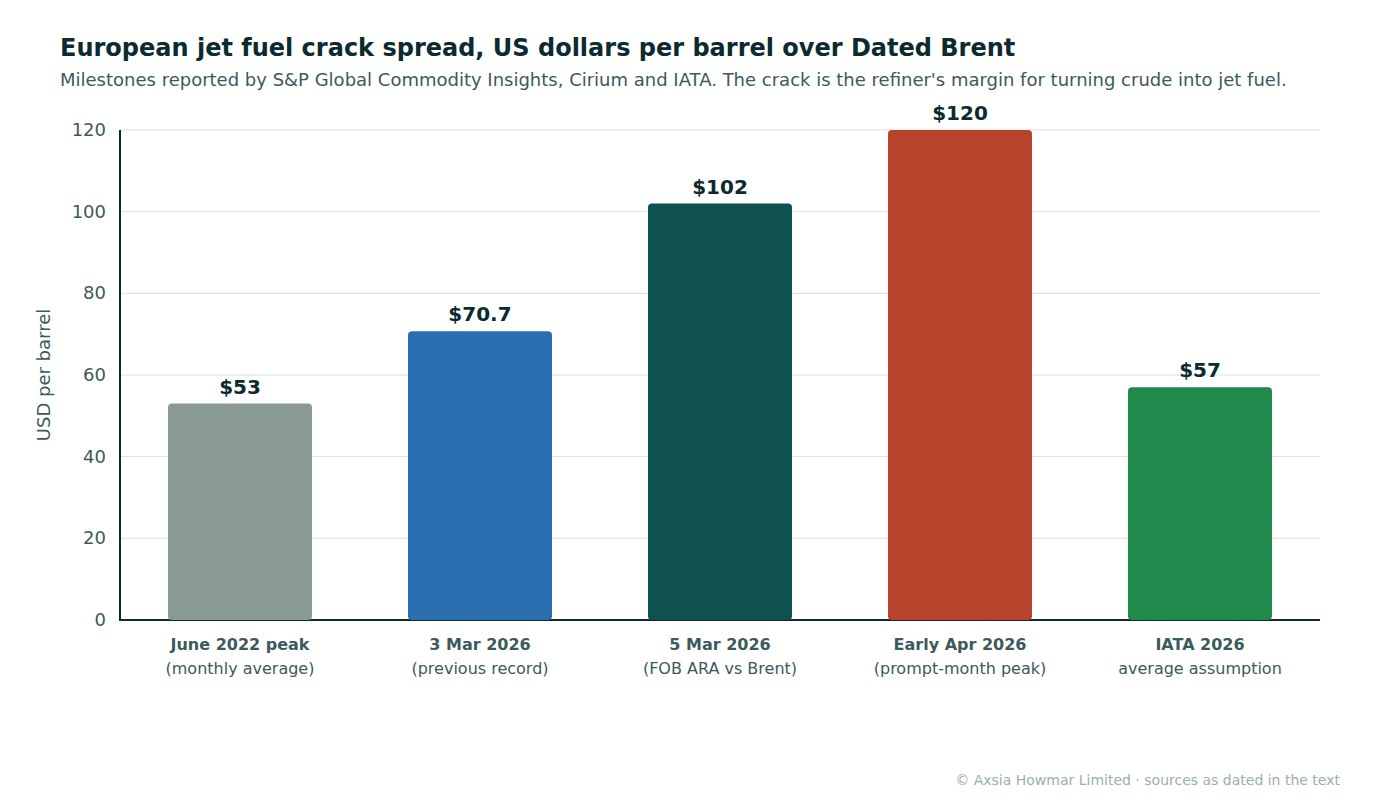
At the end of February 2026 the war with Iran closed the Strait of Hormuz to most tanker traffic. Within days the price of jet fuel in Europe had broken every record on the books: the benchmark crack spread, the margin a refiner earns for turning a barrel of crude into a barrel of jet, went from a previous all-time high of 70.70 US dollars a barrel on 3 March to 102 dollars on 5 March, and the prompt-month crack touched 120 dollars in early April. For comparison, the peak of the 2022 energy crisis was a monthly average of 53 dollars. By early April European jet prices had risen 95 % since the strikes of 28 February, and by August the International Energy Agency (IEA) counted jet fuel exports from the affected regions down by about 670,000 barrels a day year on year, a third of global trade.
A ceasefire in April reopened the strait only partially, and the IEA reported it effectively closed again in early July, with loadings down from 20 million to about 12 million barrels a day. Brent crude peaked at 118 dollars at the end of March, fell back to the low 70s at the start of July and was near 97 dollars by the end of that month. As of the IEA’s August report, the strait had not returned to normal operation.
Why Europe is the region that feels it most
Jet fuel is not short everywhere in the same way. Europe is exposed for a structural reason that predates the war: it no longer refines enough of its own kerosene. European refining capacity has fallen by roughly a fifth over two decades while global capacity grew by 16 %; four European refineries stopped processing crude in 2025 alone, taking out about 400,000 barrels a day, among them Grangemouth in Scotland and Shell’s Wesseling site near Cologne. The region consumed about 1.6 million barrels a day of jet fuel in 2025 and imported a large share of it: the International Air Transport Association (IATA) puts the imported share at roughly 60 % of consumption, and before the closure 42 % of the seaborne jet fuel imported by the EU-27 and the United Kingdom passed through the Strait of Hormuz. Northwest Europe and the Mediterranean sourced about half their jet imports from the Gulf in 2025; add India and the Far East, which also ship through or around the same chokepoints, and most of the imported barrels had the same problem at once.
Replacement cargoes exist, but they are slow and expensive. United States exports to Europe rose to about 400,000 tonnes in March, against the 1.4 million tonnes the EU and UK imported in a normal month in 2025. A cargo routed round the Cape of Good Hope takes 38 to 42 days to reach Northwest Europe rather than 23 to 25 through the Red Sea, so even when supply is found, stocks run down before it lands. Goldman Sachs estimated in May that European inventories would fall below the IEA’s 23-day threshold in June; stocks at the Amsterdam-Rotterdam-Antwerp hub had already halved since late February and stood at their lowest since April 2020.
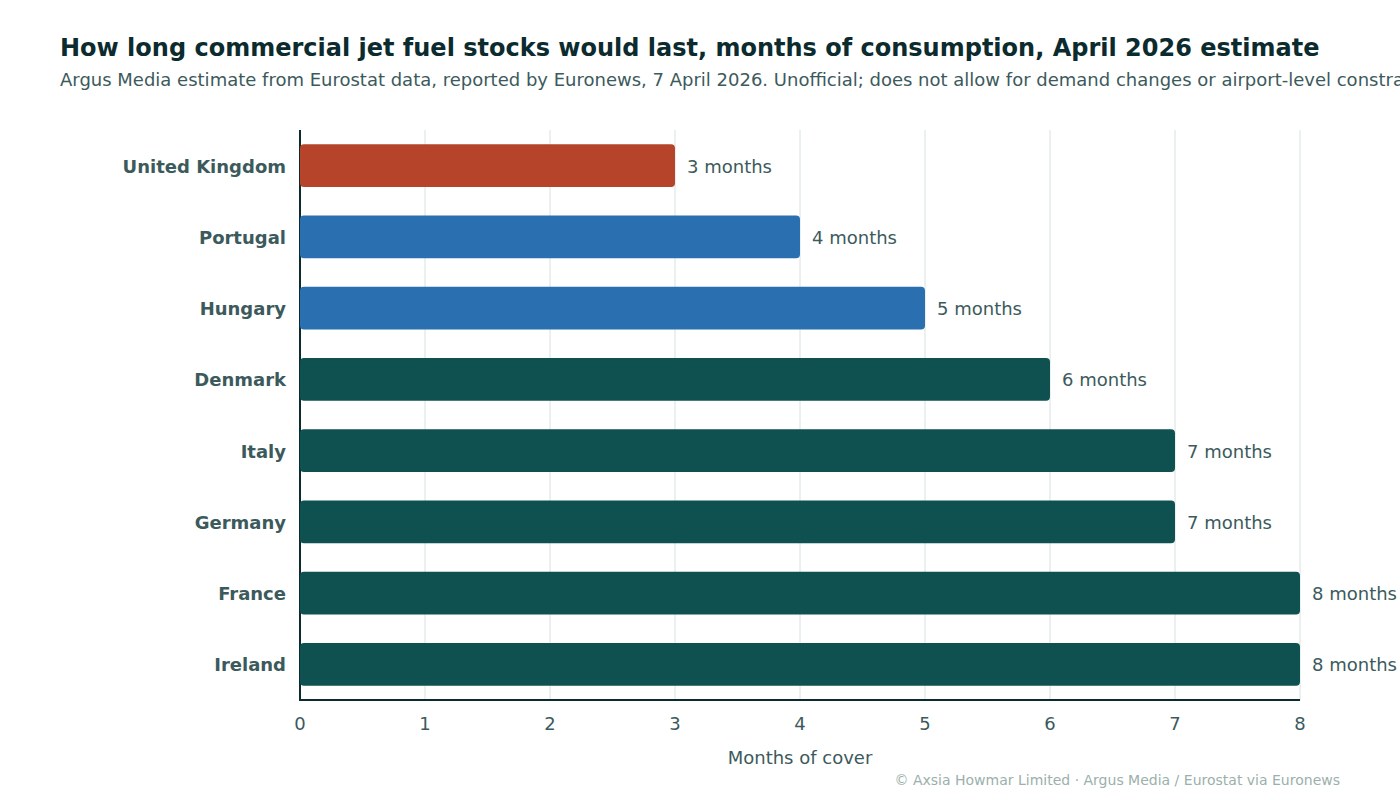
The exposure is uneven inside Europe. The United Kingdom, which lost its last Scottish refinery in 2025 and relies on imports for most of its jet, was estimated in April to hold about three months of commercial cover, against seven for Italy and Germany and eight for France. Italy introduced rationing at airports in April; airlines cut schedules across the continent, with Lufthansa alone removing 20,000 summer services to save 40,000 tonnes of fuel, and 19 of the world’s 20 largest airlines reducing capacity for May. EU energy ministers were by June discussing a coordinated release of jet fuel from strategic reserves, something Europe has not had to contemplate before.
What it means for the industry, beyond the airlines
IATA now expects jet fuel to average 152 dollars a barrel in 2026, 69 % above 2025, on an industry fuel bill of 350 billion dollars; passenger growth has been cut from 4.9 % to 2.1 %. For refiners the picture is the mirror image: Atlantic Basin margins hit all-time highs in July and again in August as diesel, jet and gasoline cracks surged together. Every European refinery that can make jet fuel is being asked to make more of it, and the typical jet yield of about 10 % of crude throughput is being pushed towards 13 %.
That is where the crisis reaches the equipment we work on. Jet yield is not set by the crude unit alone; it is set by what the kerosene treating train can process to specification. Three constraints show up first when a refinery pushes kerosene.
The first is the kerosene sweetening unit. A large share of European jet is made by caustic sweetening of straight-run kerosene to convert mercaptans, and the unit’s capacity to deliver bright, clear, on-specification fuel is often limited by the electrostatic prewash coalescer, the vessel that removes entrained caustic and water before the product goes to storage. A coalescer that lets caustic through produces hazy fuel, failed water-separation tests and off-specification batches at the moment the refinery can least afford them. Running the unit above its design rate, or on a wider kerosene cut to lift yield, makes the problem worse, because the heavier cut carries more surfactant and the droplets are harder to coalesce.
The second is hydrogen. The alternative route to jet, hydrotreating kerosene and jet-range material from other units, needs hydrogen that most European refineries already run short of. A pressure swing adsorption (PSA) unit that is limping on an old adsorbent charge, or that was sized for a reformer that has since been revamped, becomes the ceiling on the hydrotreater. Recovery lost in the PSA is hydrogen that has to be bought or produced at the margin, and in 2026 that margin is expensive.
The third is the crude unit itself. Refiners chasing kerosene are running crudes they did not run before, from the United States, West Africa and Brazil in place of Gulf grades, with different salt, water and solids. The desalter is the first vessel those crudes meet, and a desalter tuned for one crude slate does not automatically perform on another; carry-over of water and salt into the preheat train and the column shows up as corrosion, fouling and, eventually, a lower throughput than the refinery is trying to achieve.
What refiners can do this year
None of these constraints needs a new unit. A kerosene sweetening prewash coalescer that is producing hazy product can be assessed on its operating data and, in most cases, improved by changes to the electrode grid, the power unit setting, the caustic circulation or the internals; where the vessel is undersized for the new rate, a revamp of the internals is a shutdown job rather than a capital project. A PSA that has had a change of feed or duty can be reviewed against the conditions it runs at now, and in many cases a re-specified adsorbent charge recovers the purity and recovery that the refinery is losing. A desalter being asked to treat an unfamiliar crude can be re-tuned on wash water rate, mix valve pressure drop, interface level and grid voltage, and if the crude is heavier or more conductive, re-specified with the power unit tappings and grids to match.
The common thread is that the equipment which limits jet yield in 2026 is mostly thirty or forty years old, was designed for a different crude slate and a different throughput, and has not been looked at as a bottleneck because, until February, kerosene was the product nobody worried about. Axsia Howmar designs and manufactures electrostatic coalescers and prewash coalescers, hydrogen PSA packages and their adsorbent charges, and supplies spare parts for coalescers of any make; our engineers review units built by others as readily as our own. If your refinery is being asked for more jet fuel than its treating train was built for, that is a conversation worth having before the next turnaround is planned.
Sources
Figures in this article are drawn from the public sources listed below, as published on the dates shown. Where sources differ, the article uses the more conservative figure and says so.