Spare parts: adsorbent charges

AXSICANT adsorbents for PSA and TSA units

AXSICANT is the Axsia Howmar range of adsorbents for hydrogen PSA and TSA units: coconut-shell activated carbon, silica gel for heavy hydrocarbons, activated alumina and molecular sieve in 3A, 4A, 5A and 13X grades. Each grade was selected after laboratory comparison for its duty in a layered bed, and every order is specified as a charge for a named unit: grades, quantities and loading sequence per bed, for Axsia Howmar packages and for PSA units of any make.

AXSICANT 441 carbon, 573 silica gel, 436 alumina and 538 molecular sieve, chosen to work as one layered bed
4 grades
Charges for Axsia Howmar packages and for PSA and TSA units built by others, after a review of the unit
Any make
Grades, quantities and layer depths from the gas analysis and the cycle, not from a catalogue
Sized per bed

Request a quote How the PSA cycle works

The bed

Four adsorbents, one layered bed

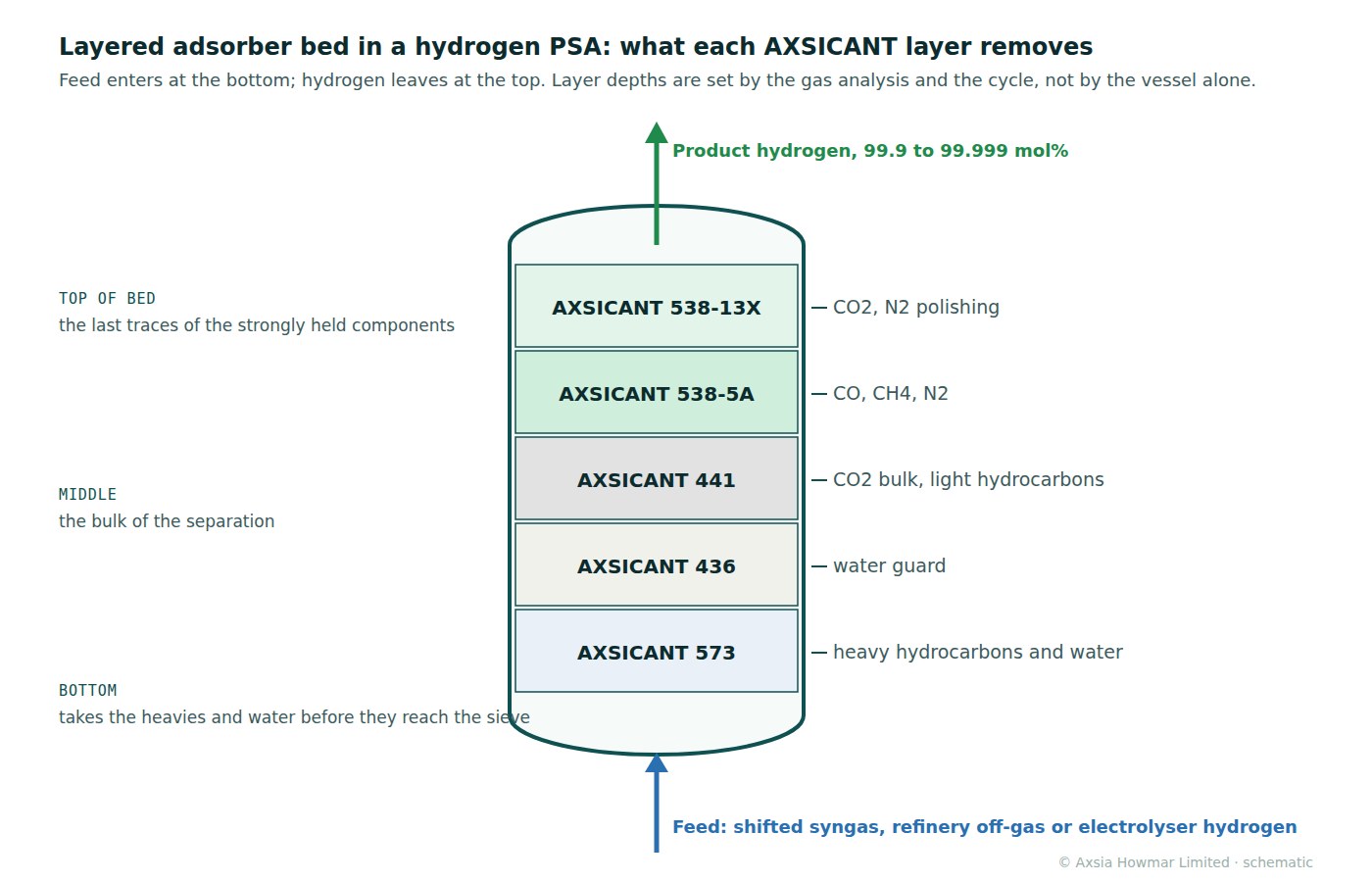
A hydrogen PSA bed is not filled with one material. It is built in layers, each chosen for the component it holds best and placed where that component arrives: silica gel at the inlet, where it takes the heavy hydrocarbons and most of the water; alumina above it as the water guard; activated carbon for carbon dioxide and the light hydrocarbons; molecular sieve at the top for carbon monoxide, methane and nitrogen, with 13X for the final polishing. AXSICANT covers all four, so the whole bed can be specified, supplied and loaded as one charge.

The grade is only half of the specification. The quantity of each layer, its depth and the loading sequence come from the gas analysis, the product specification and the cycle, which is why every AXSICANT charge is sized for a named unit by the engineers who design the PSA and DeOxo dryer packages.

How the PSA cycle works

Schematic of a layered hydrogen PSA bed: feed enters at the bottom through the AXSICANT 573 silica gel, passes the AXSICANT 436 water guard and the AXSICANT 441 carbon, and leaves through the AXSICANT 538-5A and 13X sieve layers as product hydrogen.

The range

AXSICANT grades

Sold separately, specified together. Sizes, densities and capacities below are typical values for the material types; the grade data sheets supplied with a quotation give the figures for each lot.

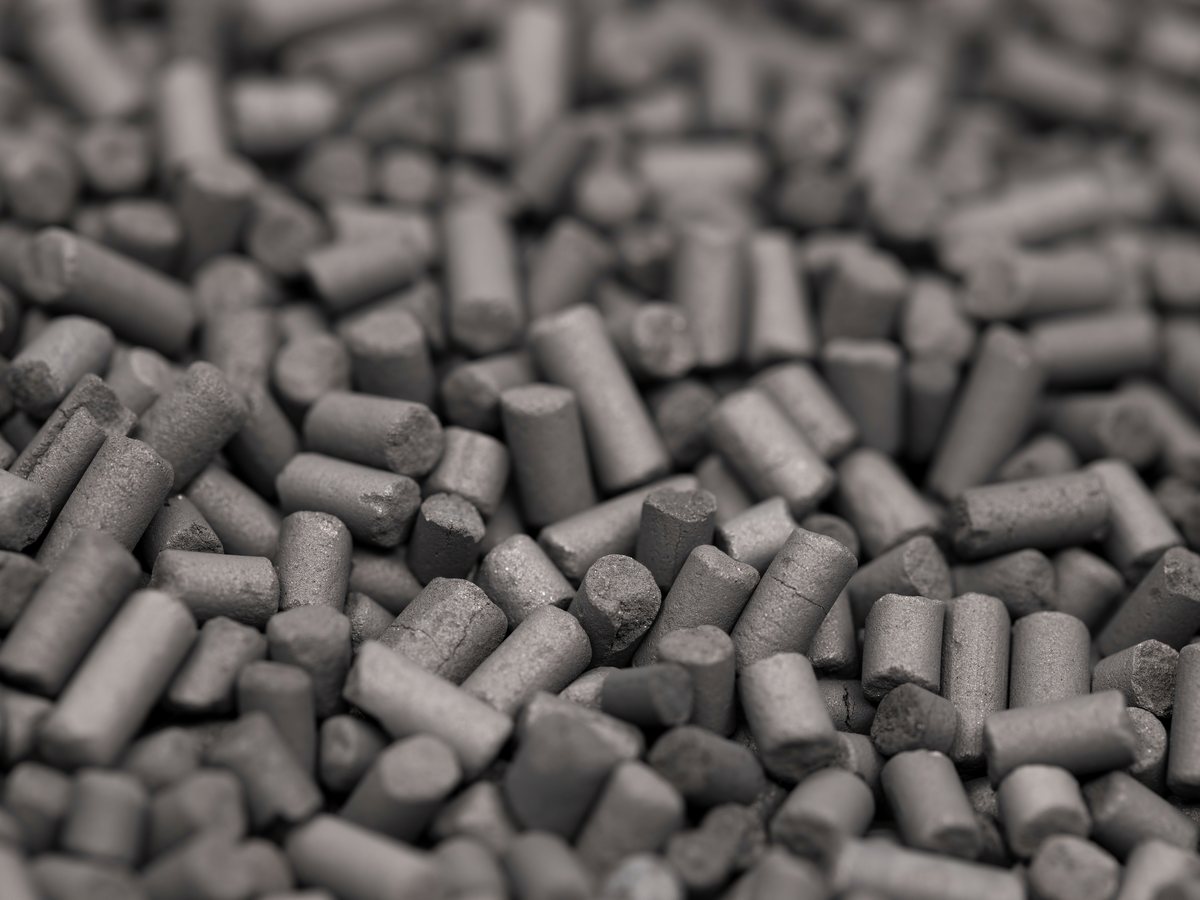
  • AXSICANT 441: Coconut-shell activated carbon

    Coconut-shell activated carbon

    AXSICANT 441

    Bulk layer of PSA beds, above the silica gel and alumina, for carbon dioxide and light hydrocarbons; guard for the sieve layers.

    • 4×8 or 8×16 mesh granules
    • Iodine number 1000 mg/g or more
    • Bulk density about 0.45 to 0.50 kg/L
    • 25 kg bags or big bags
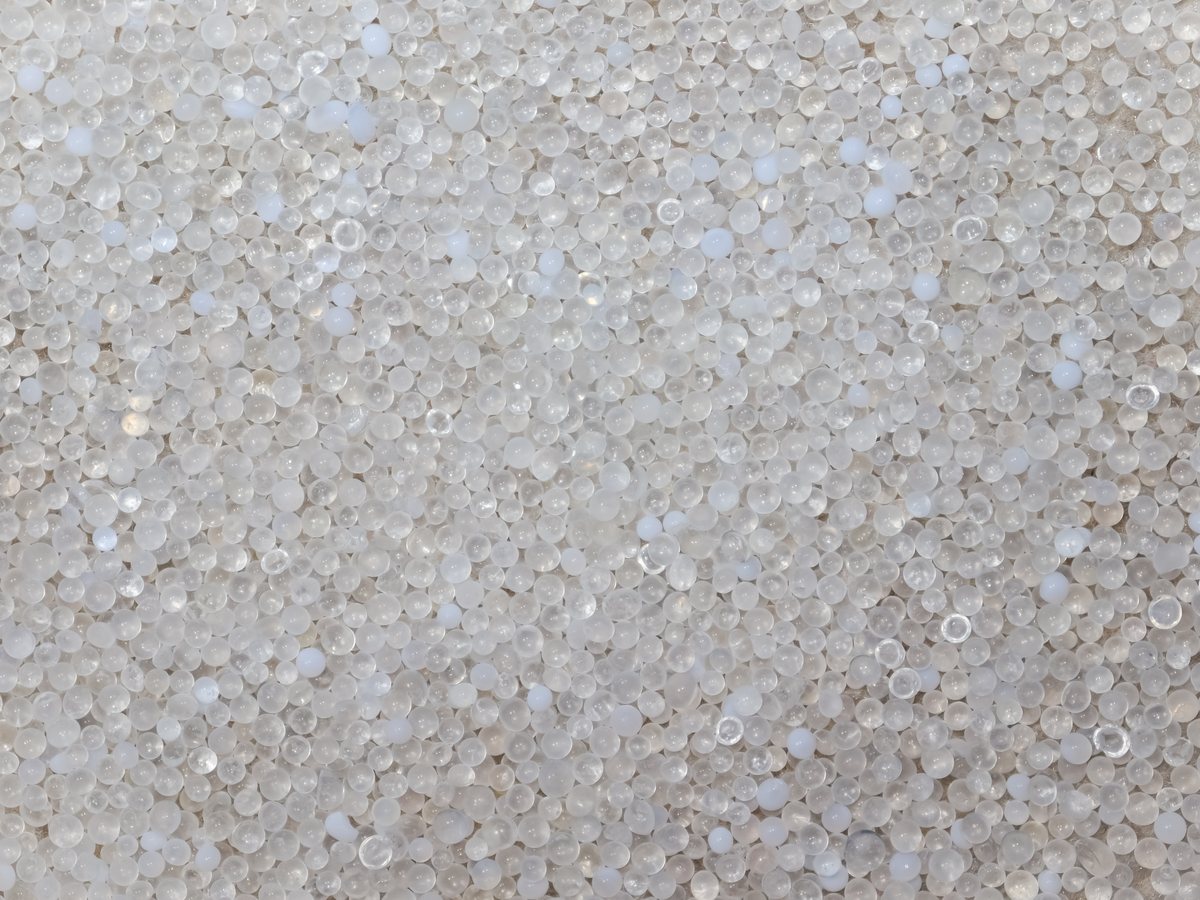
  • AXSICANT 573: Silica gel for heavy hydrocarbons

    Silica gel for heavy hydrocarbons

    AXSICANT 573

    Inlet layer for refinery off-gas and feeds carrying C5+ hydrocarbons and aromatics; releases them on the purge step.

    • 2 to 5 mm beads
    • Surface area 650 to 800 m²/g
    • Bulk density about 0.70 to 0.75 kg/L
    • 25 kg bags or drums
  • AXSICANT 436: Activated alumina

    Activated alumina

    AXSICANT 436

    Water guard layer in PSA beds; main drying layer in TSA, DeOxo dryer and regenerative gas dryers.

    • 2 to 5 or 3 to 6 mm beads
    • Surface area 300 to 350 m²/g
    • Bulk density about 0.75 to 0.80 kg/L
    • Drums or big bags
  • AXSICANT 538: Molecular sieve 3A, 4A, 5A and 13X

    Molecular sieve 3A, 4A, 5A and 13X

    AXSICANT 538

    5A for carbon monoxide, methane and nitrogen in hydrogen PSA; 13X for CO2 and nitrogen polishing; 3A and 4A for TSA drying.

    • 1.6 to 2.5 or 3 to 5 mm beads
    • Static water capacity 21 % or more
    • Bulk density about 0.64 to 0.72 kg/L
    • Lined steel drums

Selection

Chosen on breakthrough, not on price per tonne

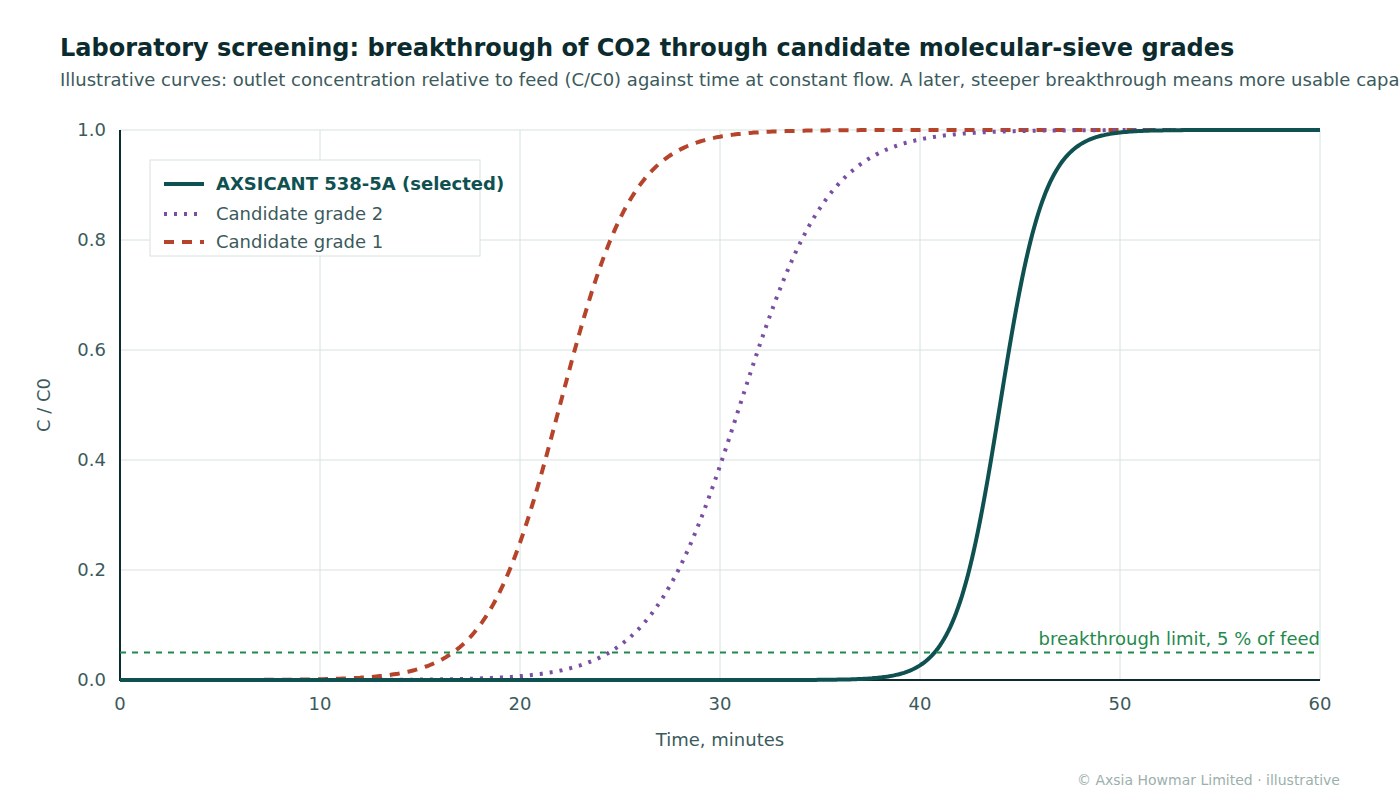
For each duty in the bed, candidate materials were compared in the laboratory on the measure that matters in a PSA: how long the bed holds the component before it breaks through at the outlet, at the pressure, temperature and flow of the service. A later and steeper breakthrough means more of the bed is working and less is a safety margin, which is what allows a smaller charge or a longer adsorption step.

Crush strength and attrition were compared as well, because a PSA bed is pressurised and depressurised every few minutes for years, and a grade that dusts fouls the valves and the downstream filters. The grade data sheets carry the figures; the chart shows the form of the comparison.

Illustrative breakthrough curves from laboratory screening: outlet concentration relative to feed against time for two candidate grades and the selected AXSICANT 538-5A.

Capacity

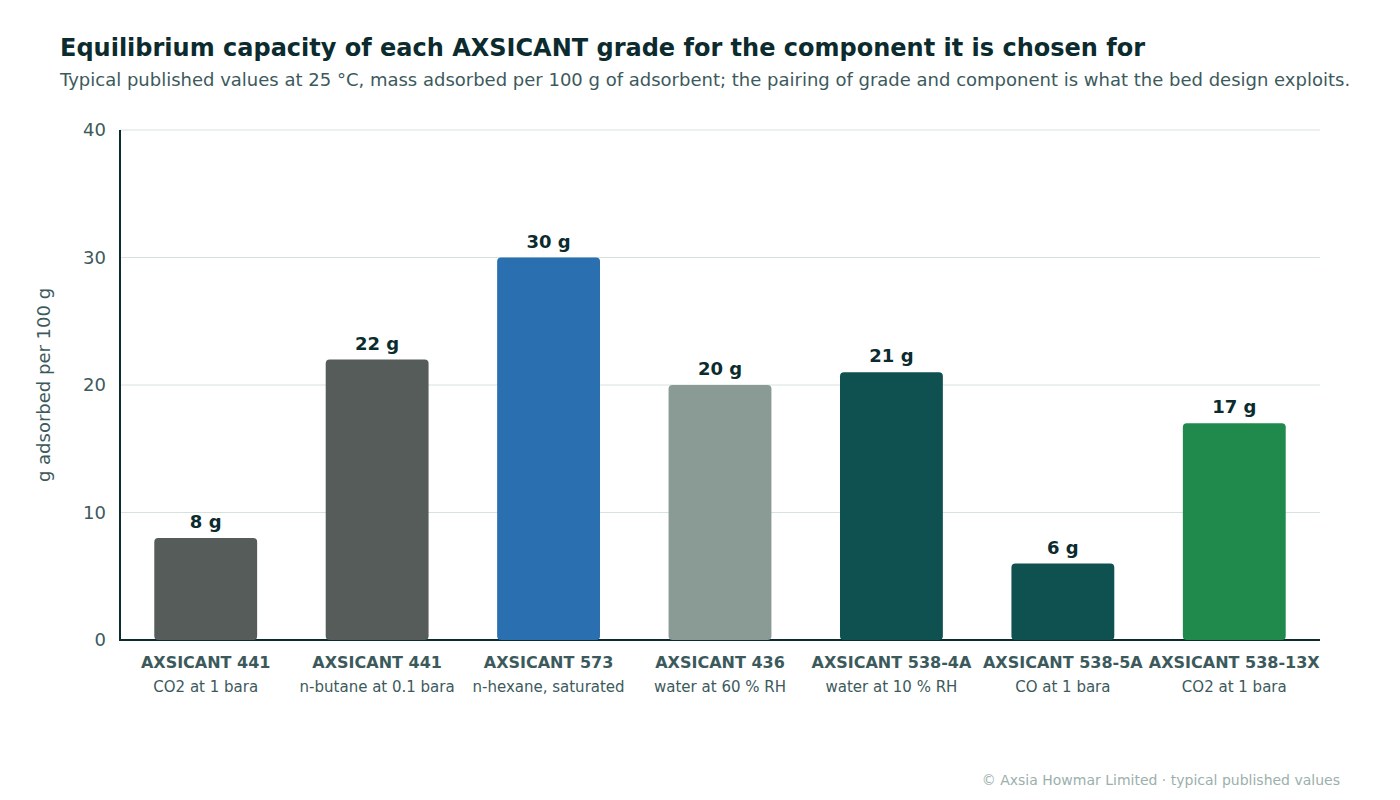
Each grade is strongest for the component it is placed to catch

No single adsorbent holds everything well. Silica gel takes up heavy hydrocarbons in quantities that carbon and sieve cannot match; carbon is the economical choice for the bulk of the carbon dioxide; alumina and 4A sieve hold water down to the dew points a dryer needs; 5A and 13X sieve hold the carbon monoxide, nitrogen and residual carbon dioxide that set the product purity. Pairing each component with the grade that holds it best, and in the right order, is the bed design.

Typical published equilibrium capacity of each AXSICANT grade for the component it is chosen for, in grams adsorbed per 100 g of adsorbent at 25 °C.

Existing PSA units

A PSA designed by someone else, and a plant that has changed since

Most PSA units outlive the conditions they were designed for. The feed changes when a reformer is revamped or a different crude is run, the purity specification tightens, the throughput creeps up, and the adsorbent in the beds is still the charge sized for the original case. Axsia Howmar reviews PSA and TSA units of any make in that situation. Send the original design basis, the current feed analysis and operating data, and the bed drawings; our engineers model the cycle against the current duty and report what the beds need now.

The recommendation stands on its own: you can use it with your incumbent supplier, or have the AXSICANT charge supplied and the change-out supervised by us.

  1. ReviewDesign basis, current feed and operating data, bed drawings; a dynamic model of the unit at the duty it has today.
  2. RecommendThe type and quantity of adsorbent for each bed, the layer depths, and the cycle changes that go with them, with the expected purity and recovery stated as a design estimate.
  3. Supply and change outThe AXSICANT charge in the agreed packaging, the loading sequence, change-out supervision and a restart check.

Design review for capacity enhancement

What we need

Four things that size a replacement charge

Any one of these is enough to start. Send what you have and we will ask for the rest.

  • Unit nameplate and vendor

    Maker, model, number of beds, design capacity and the year it was built.

  • Bed drawing or volume

    Vessel diameter and bed height, support and hold-down details, and the current layer list if it is known.

  • Feed gas analysis

    Composition, pressure, temperature and flow as the unit runs now, with the product purity and recovery you need.

  • Operating history

    Current adsorbent and its age, the reason for change, upsets or liquid carry-over, and the shutdown window.

Applications

Where the charges go

  • Hydrogen PSA units

    First and replacement charges for PSA units on reformers, refinery off-gas and electrolyser hydrogen, of any make.

  • TSA and DeOxo dryers

    Alumina and 4A sieve charges for drying electrolyser hydrogen and for regenerative gas dryers.

  • Refinery off-gas

    A silica gel inlet layer that protects the sieve from C5+ hydrocarbons and aromatics.

  • Units after a change of duty

    A review of the unit and a recommendation of adsorbent type and quantity for the conditions it runs at now.

In depth

One name, four adsorbents, one bed design

AXSICANT is the Axsia Howmar range of adsorbents for hydrogen pressure swing adsorption (PSA) and temperature swing adsorption (TSA) units: coconut-shell activated carbon (AXSICANT 441), silica gel for heavy hydrocarbons (AXSICANT 573), activated alumina (AXSICANT 436) and molecular sieve in the 3A, 4A, 5A and 13X grades (AXSICANT 538). The four are sold separately, but they are chosen to work together in a layered bed, and the bed design is where the value lies: the grade, the quantity and the depth of each layer are set from the gas analysis, the product specification and the cycle, by the same engineers who design the PSA and DeOxo dryer packages.

Each grade was selected after laboratory comparison of candidate materials for the duty it has in the bed: breakthrough time and usable capacity at the conditions of a hydrogen PSA, crush strength and attrition for a bed that is pressurised and depressurised every few minutes, and the residual capacity after repeated regeneration for TSA service. The grade data sheets give the figures; the charts on this page show the kind of comparison the selection rests on.

Supplied as a charge, not a commodity

An AXSICANT order is specified as a charge for a named unit: the grades and quantities per bed, the loading sequence from the bottom support to the top hold-down, the packaging that suits the site, and the loading and start-up notes. For Axsia Howmar packages the charge is part of the design. For units built by others it follows a review of the unit, described below, so that the replacement charge is sized for the duty the unit has today rather than the one it was built for.

Typical data

Values are typical published ranges for the material types. The grade data sheets supplied with a quotation give the figures for each lot.

Typical data for the AXSICANT grades
PropertyTypical valueBasis
AXSICANT 441: granule size4×8 or 8×16 meshCoconut-shell activated carbon; typical grades, data sheet to be confirmed
AXSICANT 441: iodine number1000 or more mg/gTypical for coconut-shell carbon of this grade
AXSICANT 573: bead size2 to 5 mmSilica gel for heavy hydrocarbons; typical
AXSICANT 573: surface area650 to 800 m2/gTypical published range for this type of silica gel
AXSICANT 436: bead size2 to 5, 3 to 6 mmActivated alumina; typical
AXSICANT 436: surface area300 to 350 m2/gTypical published range
AXSICANT 538: bead size1.6 to 2.5 or 3 to 5 mmMolecular sieve 3A, 4A, 5A, 13X; 8×12 and 4×8 mesh
AXSICANT 538: static water capacity21 or more % by massTypical at 25 °C and 10 % relative humidity
Bulk density, all grades0.45 to 0.80 kg/LCarbon lowest, alumina highest; used in bed sizing
Packaging25 kg bags, 125 to 150 kg drums, 500 to 800 kg big bagsSealed against moisture; molecular sieve in lined steel drums

Performance a charge is designed to

Performance a charge is designed to
MeasureTypical valueConditions
Product purity, PSA charge99.9 to 99.999 mol% hydrogenTypical published range for a layered bed; set by the design case
Hydrogen recovery, PSA charge70 to 90 %Typical published range; depends on feed, pressure ratio and cycle
Dew point, TSA and DeOxo dryer chargebelow -70 °CTypical for 4A sieve after alumina; stated as a design estimate
Charge life5 to 10 yearsTypical for a PSA bed free of liquid carry-over; TSA depends on regeneration temperature and cycles

What Axsia Howmar supplies

  • Bed design: grades, quantities and layer depths per bed from the gas analysis and cycle
  • AXSICANT charge supplied to the site in the packaging and sequence agreed
  • Loading procedure, dense-loading where specified, and start-up conditioning notes
  • Change-out supervision and a restart performance check (optional)
  • Review and re-specification of PSA and TSA units built by others
  • Spent adsorbent handling guidance and safety data sheets

Test methods and documentation

Test methods and documentation
StandardTitleApplied to
ASTM D2866, D2867, D3802Activated carbon test methodsAsh, moisture and ball-pan hardness of AXSICANT 441
ASTM D4607Iodine number of activated carbonCapacity index for AXSICANT 441
ASTM D4179, D6175Crush strength of catalysts and adsorbentsBead and granule strength for all grades
ISO 9277Specific surface area by gas adsorption (BET)Surface area of silica gel, alumina and sieve
UN packaging and SDS to GHSPackaging and safety dataEvery grade shipped with a safety data sheet

Stock and packaging

Packed for the site, shipped against the shutdown date

Charges are packed to suit the loading method and the site: 25 kg bags for hand loading, 125 to 150 kg lined steel drums for molecular sieve, and big bags of 500 to 800 kg for dense loading by hopper. Every lot leaves with its grade data sheet, safety data sheet and certificate of conformity, and molecular sieve is sealed against moisture until the bed is ready for it.

Lead times depend on the grade and quantity and are confirmed at quotation; a replacement charge is normally scheduled against the shutdown window rather than shipped from stock, so that nothing sits on site absorbing moisture.

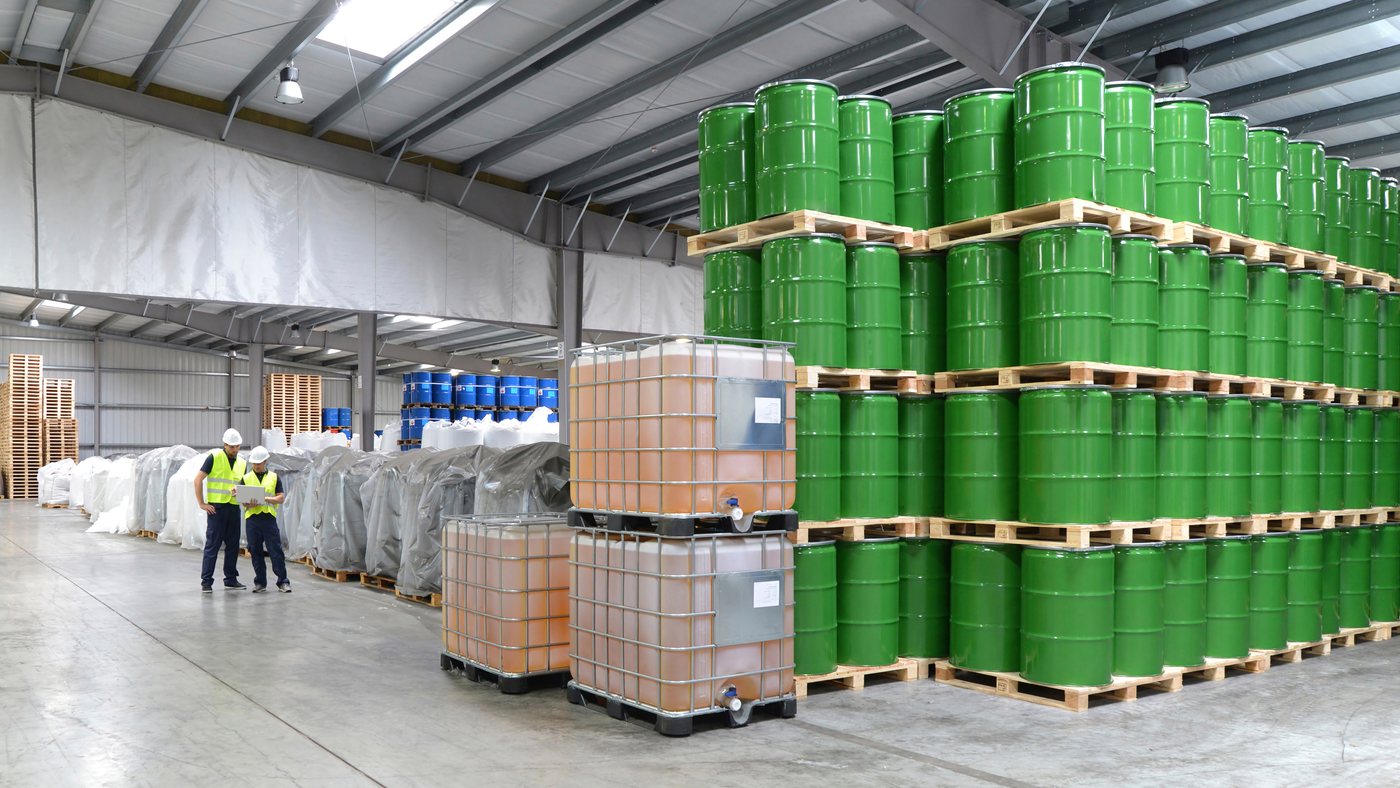
Adsorbents in drums, intermediate bulk containers and big bags, palletised for shipment.

Questions engineers ask

Frequently asked questions

Will you review a PSA that Axsia Howmar did not design?

Yes. Send the original design basis, the current feed analysis and operating data, and the bed drawings. We model the cycle against the duty the unit has now and report the type and quantity of adsorbent each bed needs, with the layer depths and any cycle changes that go with them. The recommendation stands on its own: you can use it with your incumbent supplier or have the AXSICANT charge supplied and the change-out supervised by us.

Activated carbon or silica gel for heavy hydrocarbons?

Both have a place, and the order matters. AXSICANT 573 silica gel goes in first, at the inlet, because it takes up heavy hydrocarbons and water reversibly at the purge pressure; that protects everything above it from fouling that a PSA cycle cannot undo, which is why it is specified wherever the feed carries C5+ hydrocarbons or aromatics, as refinery off-gas often does. AXSICANT 441 activated carbon sits above the alumina guard and does the bulk work on CO2 and the light hydrocarbons. On a clean reformer feed the silica gel layer is thin; on refinery off-gas it is the layer that decides charge life.

Which molecular sieve grade goes in a hydrogen PSA?

5A is the working grade for CO, methane and nitrogen in a hydrogen PSA; 13X is used where CO2 or nitrogen polishing is the limiting duty; 4A and 3A are drying grades for TSA and DeOxo dryer beds rather than for PSA separation. The bed design, not the catalogue, decides the split between them.

How long does a charge last, and what shortens it?

A PSA charge that sees dry, clean gas typically runs for many years, because the cycle regenerates it on every step. What shortens its life is liquid carry-over, heavy hydrocarbons reaching the sieve, oil mist from a compressor, and mechanical attrition from valves that open too fast. A TSA charge ages with regeneration temperature and cycle count. A review of the operating history is part of every replacement quotation.

Are the laboratory results on this page from Axsia Howmar tests?

The charts show the form of the comparisons the grades were selected on. Grade data sheets with the test figures are supplied with a quotation; the values on this page are typical published ranges for the material types, and nothing on this page is a performance guarantee.