
Hydrogen purification

TSA hydrogen purification

Temperature swing adsorption (TSA) removes water and other strongly held trace impurities from a gas by adsorbing them at ambient temperature and releasing them by heating the bed. Axsia Howmar supplies TSA for gas dehydration and, combined with a catalytic deoxidiser in a DeOxo dryer package, for electrolyser hydrogen, taking it from 99.9 to 99.999 % purity.

A TSA bed cycles on temperature over hours; a PSA bed cycles on pressure in minutes
Hours, not minutes
Electrolyser hydrogen before and after a DeOxo dryer package
99.9 to 99.999 %
Typical water and oxygen in the product of a DeOxo dryer package
Below 5 ppm

Send a technical enquiry The DeOxo dryer package

How it works: TSA hydrogen purification

  1. Deoxidation (DeOxo packages only)

    Hydrogen passes over a precious-metal catalyst. Residual oxygen reacts with hydrogen to form water. The reaction releases heat, so the gas leaves warmer and wetter.

  2. Cooling and water knock-out

    A cooler condenses most of the water, and a separator removes it, so that the dryer handles only the vapour that remains.

  3. Adsorption

    Gas flows through a bed of desiccant, typically molecular sieve or activated alumina, which holds the water. Dry gas leaves as product.

  4. Regeneration by heating

    The second bed is heated with a slip stream of gas to drive off the water it collected. The wet regeneration gas is cooled, its water is removed, and it is recycled or vented.

  5. Cooling and changeover

    The regenerated bed is cooled to adsorption temperature and the beds change over. A full cycle takes hours, not minutes.

How it works

Two beds: one adsorbs while the other regenerates

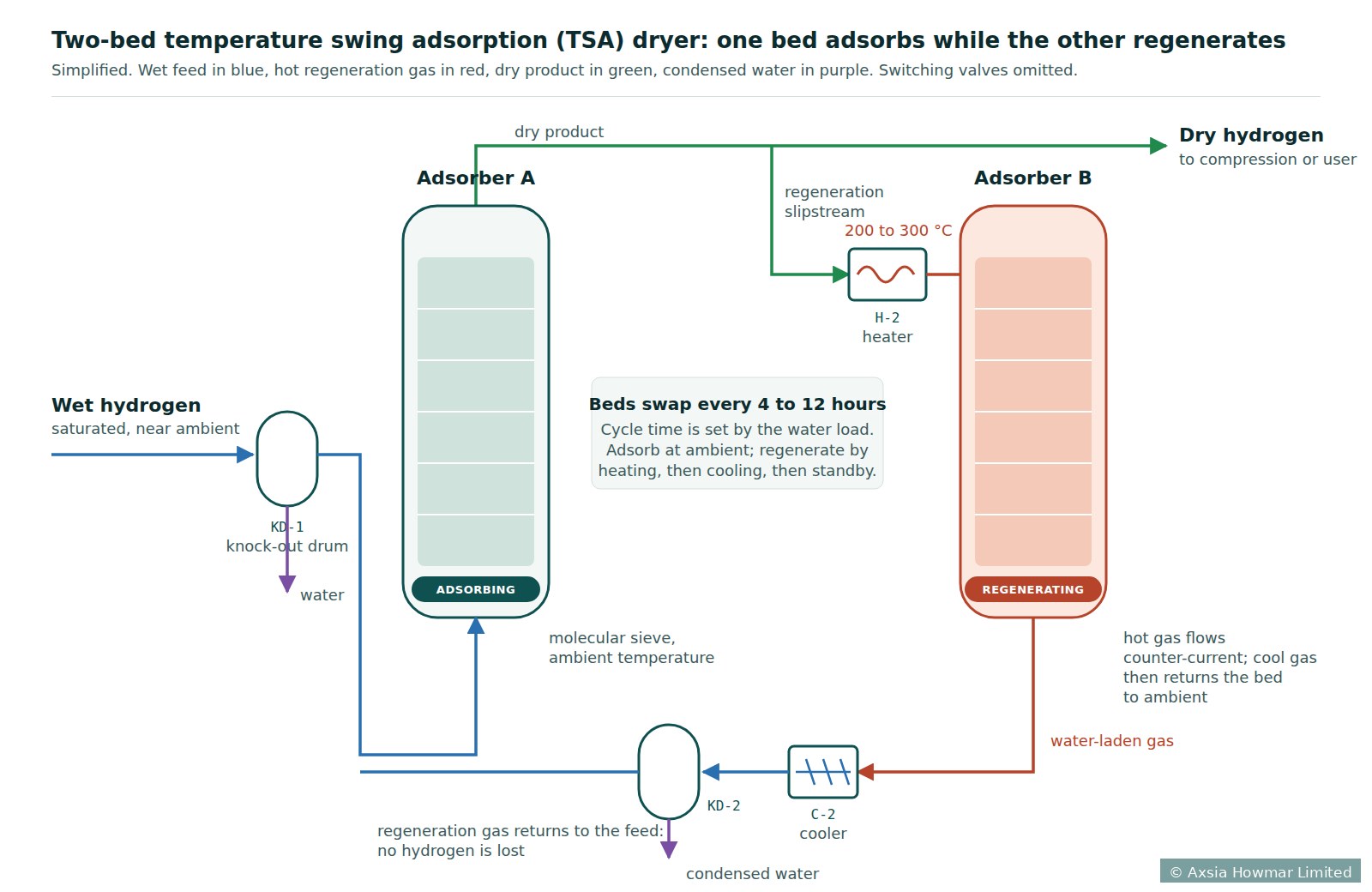
Wet gas passes up through a bed of molecular sieve at near-ambient temperature and leaves dry. Meanwhile a slipstream of dry product is heated to 200 to 300 °C and passed down through the second bed, driving off the water it collected in its previous cycle. The wet regeneration gas is cooled, its water knocked out, and it is returned to the feed, so no hydrogen is lost. After heating comes a cooling step, then standby, and the beds swap.

Because the water load is small and strongly held, a bed stays on line for hours rather than the minutes of a PSA cycle. The cycle time, the heater size and the regeneration gas rate are traded against each other in the design.

Simplified flow of a two-bed TSA dryer with closed-loop regeneration: adsorber A on line, adsorber B being regenerated with heated product gas. Switching valves omitted.

Why heat works

Why heating regenerates the bed

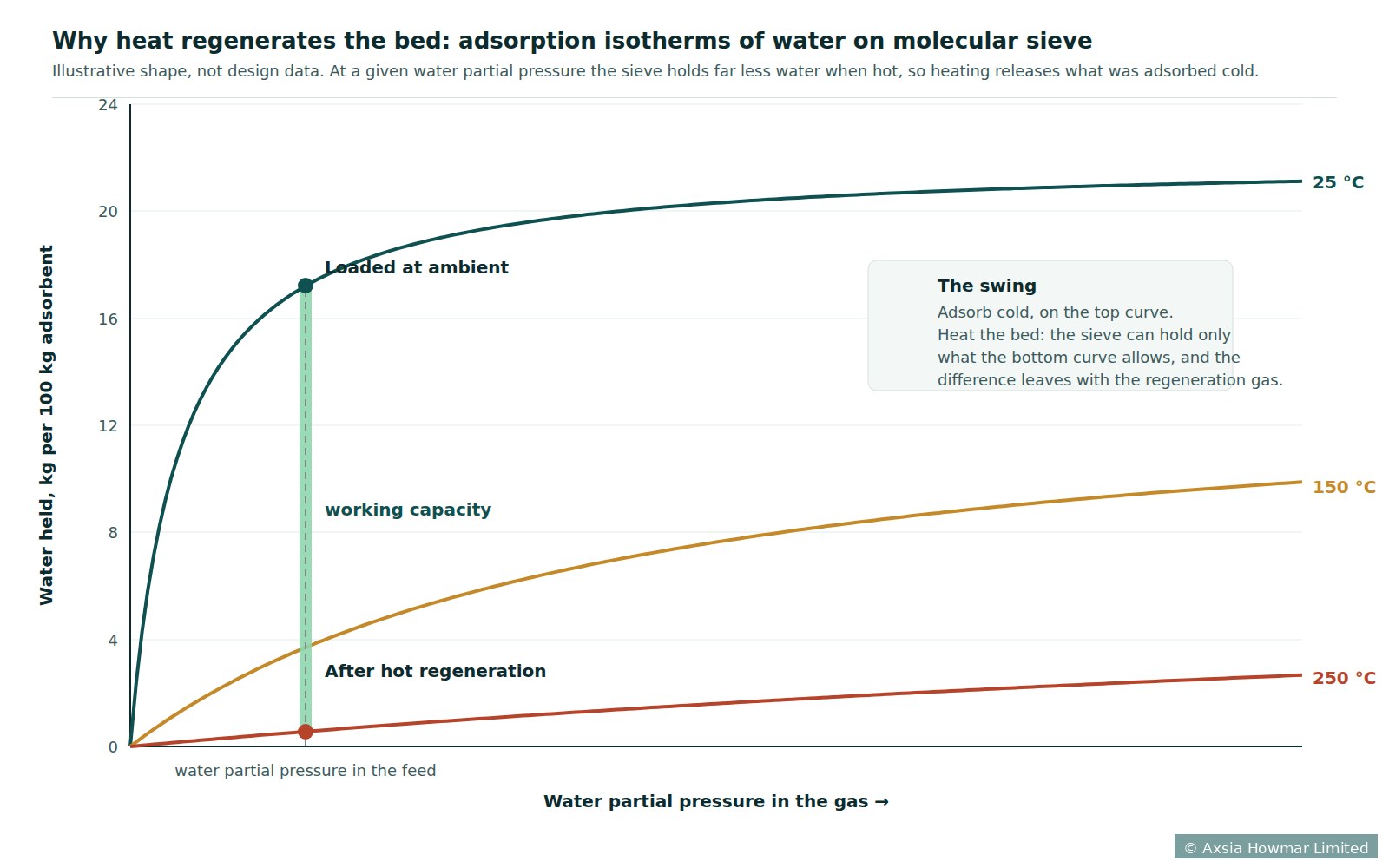
How much water a molecular sieve holds depends on the water partial pressure in the gas and on temperature. At ambient temperature the sieve holds a great deal of water even from a gas that is nearly dry, which is what makes it a good desiccant. Heat the same bed and its capacity at that partial pressure collapses; the difference is released into the regeneration gas.

The working capacity of the bed is the gap between the cold and hot curves at the feed condition, and it is this gap, not the total capacity, that sizes the adsorbers. The higher the regeneration temperature, the wider the gap and the smaller the beds, at the cost of heater duty and adsorbent life.

Illustrative adsorption isotherms of water on molecular sieve at three temperatures. The shaded bar is the working capacity between adsorption at ambient and regeneration when hot.

DeOxo dryer package

With a deoxidiser: the DeOxo dryer package for electrolyser hydrogen

Hydrogen from an electrolyser is nearly pure but saturated with water and carries a few thousand parts per million of oxygen. A precious-metal catalyst first converts the oxygen to water, the gas is cooled and the water knocked out, and the TSA dryer then removes the rest. The package delivers purity of up to 99.999 % with oxygen and water below 5 ppm, from 50 to 20,000 Nm³/h.

The DeOxo dryer package in detail

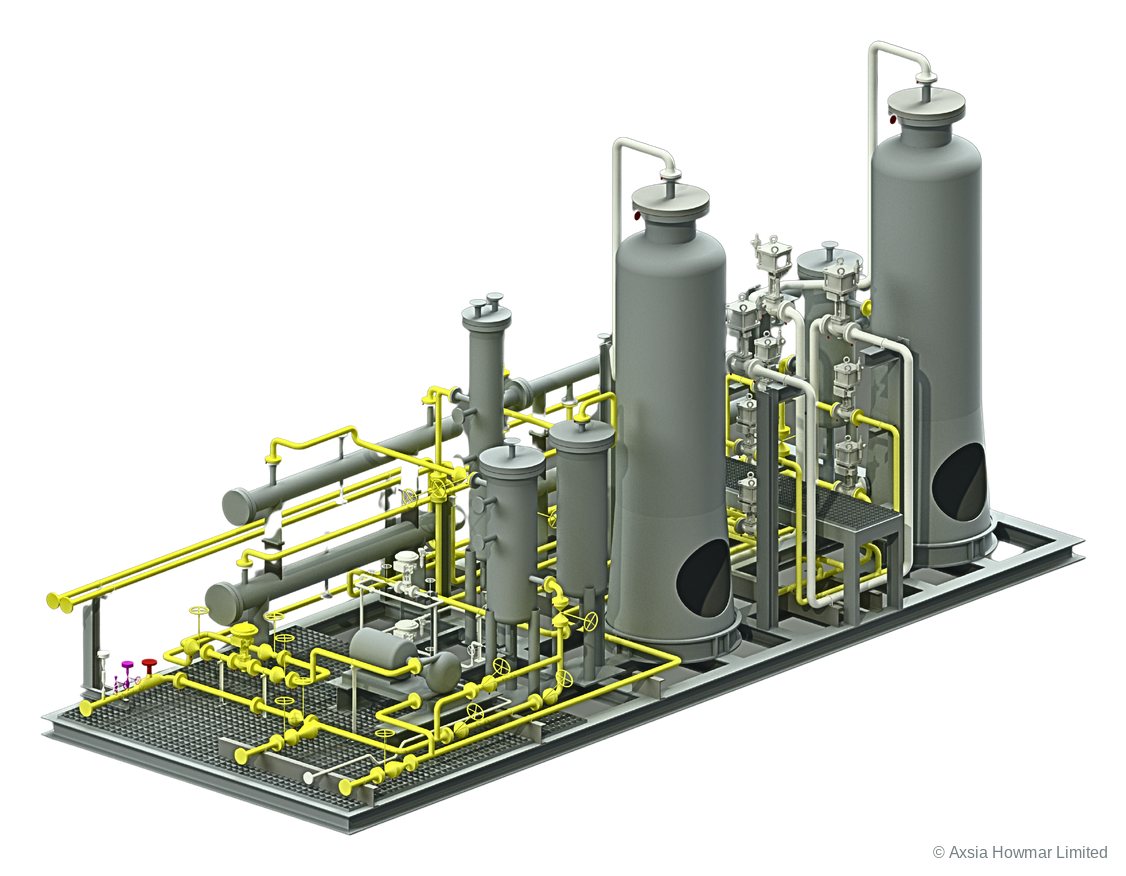
3D model of a DeOxo TSA dryer skid: reactor, twin adsorbers, coolers, knock-out drums, heaters and filters with interconnecting piping on one frame.

Proven at pilot scale

Design methods checked on a hydrogen drying pilot plant

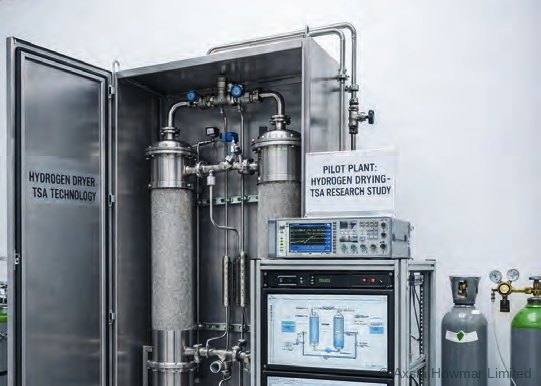
The cycle models, adsorbent behaviour and regeneration programmes behind each proposal have been checked against measurements on a TSA hydrogen drying pilot system, so heaters, coolers and blowers are sized on transients that have been seen in practice, and the regeneration programme keeps hot liquid water off the adsorbent.

TSA hydrogen drying pilot system used for the research study behind the design method.

TSA is not PSA

The two adsorption processes are not interchangeable

PSA removes percent-level impurities by cycling pressure every few minutes. TSA removes trace, strongly held impurities by cycling temperature over hours. A feed from a reformer needs PSA. A feed from an electrolyser needs a deoxidiser and a TSA dryer. The comparison is set out in PSA vs TSA for hydrogen purification.

Where a TSA dryer or DeOxo dryer package sits in the process

A DeOxo dryer package sits directly downstream of the electrolyser’s gas-liquid separator and any demister, and upstream of compression, storage or the user. A TSA dehydration unit sits wherever a process needs dry gas: ahead of low-temperature equipment, ahead of moisture-sensitive catalysts, or as the last step before a pipeline or fuelling specification.

TSA is not interchangeable with PSA

TSA and PSA both use adsorbent beds, and that is where the similarity ends. PSA removes percent-level impurities by cycling pressure every few minutes. TSA removes trace, strongly held impurities by cycling temperature over hours. A feed from a reformer needs PSA. A feed from an electrolyser needs a deoxidiser and a TSA dryer. The comparison is set out in PSA vs TSA hydrogen purification.

Design and selection considerations for TSA dryers and DeOxo dryer packages

The design of a TSA dryer or DeOxo dryer package starts from the water and oxygen load and how it varies. The points that decide the design are:

  • Inlet conditions. Water content follows temperature and pressure at the electrolyser outlet. A few degrees of extra cooling upstream removes a large share of the water load before it reaches the desiccant.
  • Oxygen range. Electrolyser oxygen crossover rises at low load. The deoxidiser and cooler are designed for the highest expected level, within the safety limits of the electrolyser.
  • Turndown and intermittent operation. Electrolysers on renewable power start, stop and ramp. The cycle logic must handle partial loading of a bed and regeneration during standby.
  • Regeneration heat. Electric heating is usual on electrolyser sites. Heater size and cycle time are traded against each other.
  • Regeneration gas route. Recycling regeneration gas avoids hydrogen loss at the cost of a cooler, separator and sometimes a blower.
  • Product analysis. Trace moisture and oxygen analysers confirm the specification, and their sample systems need the same care as the process.

Materials used in TSA dryers and DeOxo dryer packages

TSA adsorber vessels are normally carbon steel or stainless steel depending on the purity and cleanliness specification, with internal insulation or external insulation chosen for the regeneration temperature. Piping downstream of the dryer is kept clean and dry to protect product quality.

Common operating problems with TSA dryers and DeOxo dryer packages

The common operating problems with TSA dryers and DeOxo dryer packages are early moisture breakthrough, high product oxygen, and rising bed pressure drop. Early breakthrough usually means incomplete regeneration, a higher water load than design, or liquid water reaching the bed. High oxygen usually means a cold or poisoned catalyst. Rising pressure drop means desiccant breakdown, often after contact with liquid water. For a diagnosis, see troubleshooting and performance diagnostics.

Capacity enhancement and revamp options for TSA dryers

A TSA dryer that no longer meets its duty can often be recovered by better upstream cooling and water knock-out, a change of desiccant, a revised cycle, or a larger regeneration heater. Where electrolyser capacity is being expanded, a design review establishes whether the existing package can be re-rated or needs a parallel train.

Design parameters: TSA hydrogen purification

Design parameters: TSA hydrogen purification
ParameterTypical rangeUnitBasis / note
Adsorption temperatureNear ambient°CDesiccant capacity falls as temperature rises
Regeneration temperature150 to 300°CTypical published range; depends on desiccant
Cycle time4 to 24hTypical published range per bed
Temperature rise across the deoxidiserAbout 17 per 0.1 vol% oxygen°CCalculated adiabatic rise in hydrogen

Typical ranges for orientation only. The design basis for each unit is set from the feed analysis and the required product specification.

Performance we design to: TSA hydrogen purification

Performance we design to: TSA hydrogen purification
MetricValue or rangeUnitConditions / design basis
Product hydrogen purity, DeOxo dryer package99.9 to 99.999%Axsia Howmar packages on electrolyser hydrogen

Achievable performance depends on feed conditions and the agreed design basis. These figures are design targets, not guarantees independent of those conditions.

Codes and standards applied to TSA hydrogen purification

Typically applied; the governing codes are confirmed per project with the client and the jurisdiction.

ASME BPVC Section VIII Division 1
Pressure vessels Adsorber and deoxidiser vessels
PD 5500 / EN 13445
Unfired pressure vessels Where specified
IEC 60079 / ATEX / IECEx
Equipment for explosive atmospheres Regeneration heater, valves, instruments, panel
PED / UKCA / UKEX
Conformity marking Where required
ISO 14687
Hydrogen fuel quality Product specification for fuel cell and other uses

Applications: TSA hydrogen purification

  • Electrolyser (green) hydrogen: DeOxo dryer packages downstream of alkaline or proton exchange membrane electrolysers, ahead of compression, storage or fuelling.
  • Gas dehydration: Drying hydrogen, natural gas and other process gases to low water dew points.
  • Protection of downstream units: Removing water ahead of cryogenic equipment, catalysts or a PSA.

Scope of supply: TSA hydrogen purification

  • Process design from the electrolyser or process datasheet
  • Deoxidiser vessel and catalyst (DeOxo packages)
  • Adsorber vessels, desiccant and bed supports
  • Regeneration heater, coolers, separators and regeneration gas recycle where specified
  • Switching valves, moisture and oxygen analysers, control system
  • Skid, piping, inspection, testing, documentation
  • Delivery, commissioning, performance test run and handover

Frequently asked questions: TSA hydrogen purification

What is a DeOxo dryer?

A DeOxo dryer is a two-step purification package for hydrogen that is already nearly pure. The deoxidiser reacts residual oxygen with hydrogen over a catalyst to form water. The dryer, a temperature swing adsorption unit, then removes that water together with the water the gas arrived with. It is the standard clean-up for electrolyser hydrogen.

Why does electrolyser hydrogen need purification?

Hydrogen leaves an electrolyser saturated with water vapour and carrying a small amount of oxygen that has crossed from the oxygen side. Fuel cells, many catalysts and hydrogen storage and compression equipment need far lower levels of both. ISO 14687 Grade D, the fuel cell vehicle grade, limits water and oxygen to 5 ppm each.

Can TSA be used instead of PSA to purify hydrogen?

TSA cannot replace PSA for bulk purification. TSA beds are sized for trace impurities and are regenerated over hours, so they would saturate almost at once on a feed containing percent-level carbon dioxide or methane. TSA is the right tool when hydrogen is already pure apart from water, and, with a deoxidiser, oxygen.

How much does the gas heat up across a deoxidiser?

The calculated adiabatic temperature rise across a deoxidiser is about 17 °C for every 0.1 vol% (1,000 ppm) of oxygen reacted in hydrogen. The inlet oxygen level therefore sets the catalyst bed outlet temperature and the cooler duty, and an upper limit on oxygen is part of the design basis.

How is a TSA dryer regenerated, and where does the water go?

A TSA dryer is regenerated by passing hot gas through the bed in the opposite direction to adsorption, which drives the water off the desiccant. The wet regeneration gas is cooled and the water is condensed and drained. In hydrogen service the regeneration gas is usually recycled to the dryer inlet so that hydrogen is not lost.

Talk to an engineer about your unit

Tell us the equipment, the duty and what you are seeing. Partial data is normal: send what you have and we will tell you what else matters. We acknowledge every enquiry within 1 working day.