
Market commentary, not advice. Figures are taken from the public sources listed at the end and are correct as of the dates given; the situation is moving and some will have changed by the time you read this. Nothing here is a forecast of prices or a recommendation to trade.
What happened
Diesel, not crude, is the fuel the 2026 energy shock is being felt in. The closure of the Strait of Hormuz at the end of February took the Gulf’s refineries out of the export market: by August their net exports of diesel and gasoil had fallen to about 390,000 barrels a day, just over a quarter of the pre-war level, according to the International Energy Agency (IEA). Russia, the other large supplier to Europe before 2022, halted most product exports after Ukrainian drone attacks on its refineries and extended its diesel export ban through October. The IEA puts the combined loss from the Gulf and Russia at 1.6 million barrels a day against February. Diesel and gasoil are nearly 30 % of world oil demand, so there was nowhere for that to hide.
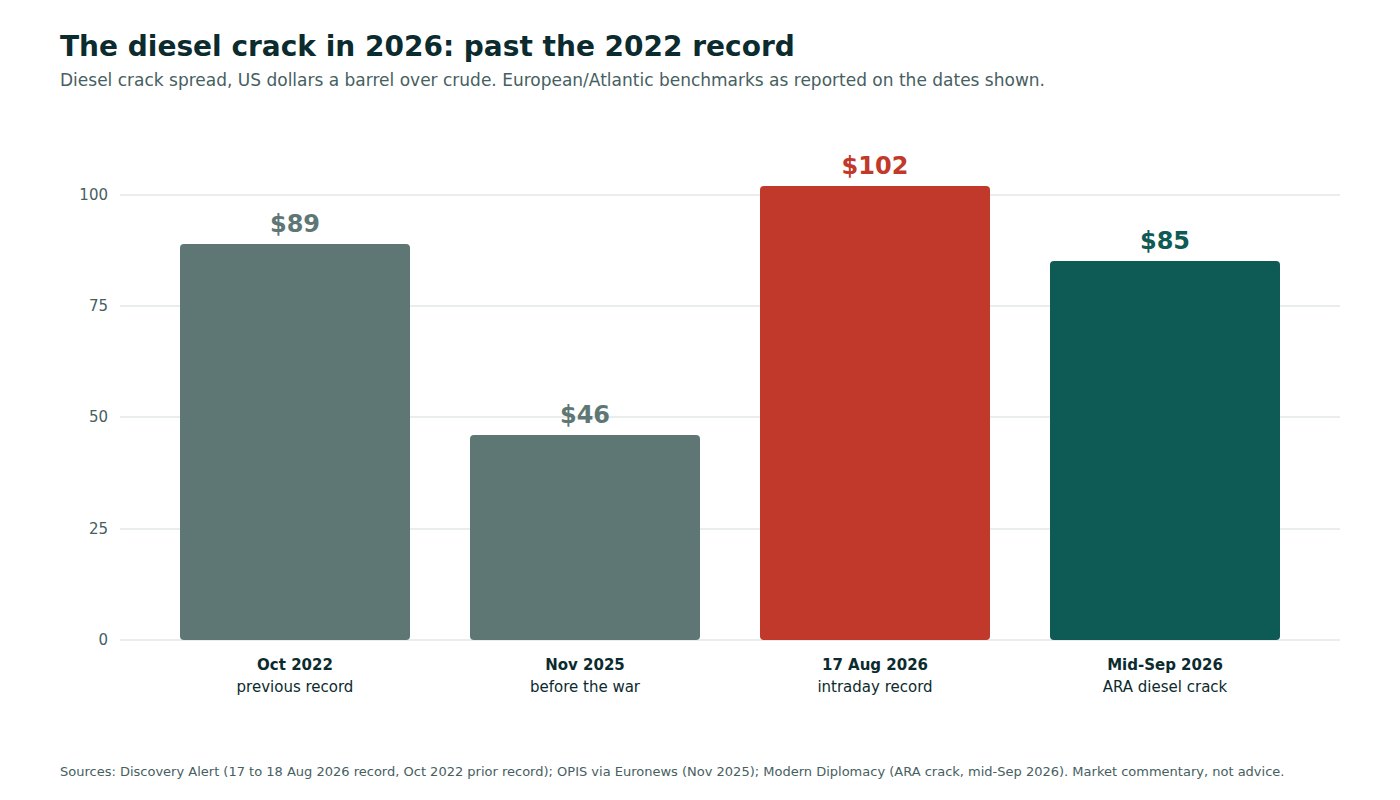
The price did what it had to. The diesel crack spread, the margin a refiner earns for turning a barrel of crude into a barrel of diesel, had already doubled from about 46 dollars a barrel in November 2025 to a record 102 dollars intraday on 17 August 2026, the first time it had settled in three figures and some 15 % above the previous record of about 89 dollars from October 2022. In the United States, diesel passed 200 dollars a barrel in early September, 94 % above pre-war levels. The northwest European benchmark reached a record 1,642 dollars a tonne on 15 September, and the average European Union pump price for diesel hit 2.24 euros a litre on 1 October, with France above 2.40 euros. Stocks in the Amsterdam-Rotterdam-Antwerp hub were at a four-year low of about 12 million barrels going into the heating season, and United States distillate inventories were at their lowest since 1996.
Why Europe is short of diesel in a way it cannot refine its way out of
Europe’s exposure is structural and predates the war. The continent runs on diesel: it is the fuel of road freight, agriculture, construction and, as heating oil, of a large share of winter heating. It has never refined enough of it, because European refineries were built for a market that wanted petrol, and it closed more than 370,000 barrels a day of refining capacity in 2025 alone. The gap was filled by imports, first from Russia and then, after 2022, from the Gulf, India and the United States. The war removed the Gulf and most of Russia at once. Replacement cargoes from the United States Gulf Coast and from India exist, but they are longer voyages, they compete with Asia for the same barrels, and a United States diesel export ban to protect domestic winter supply is openly discussed as a downside scenario.
The European Central Bank estimated that refining margins alone accounted for 41 cents of every litre sold at the pump in September, almost a fifth of the price; energy inflation in the euro area rose from 10.3 % in July to 14.3 % in August. For a refiner, the arithmetic is the mirror image: every barrel of diesel it can make and sell on specification earns a margin that was unimaginable two years ago, and every barrel it has to re-run, re-blend or downgrade costs the same amount.
The quiet problem: water, haze and the cargoes that fail on arrival
When a market is this tight, the fuel that is available travels further and sits longer. Diesel that would have moved by pipeline from a nearby refinery now arrives by sea after a voyage of weeks, has been through ship’s tanks, shore tanks and floating storage, and is blended at the terminal with fatty acid methyl ester (FAME) biodiesel, up to 7 % by volume under the European EN 590 standard. Every one of those steps is a chance to pick up water. Water dissolves in diesel in small amounts and comes out again as the fuel cools; FAME holds several times more of it than mineral diesel; the first cold nights of autumn turn dissolved water into a fine haze of droplets a few micrometres across, far too small to settle in a tank in any useful time.
A hazy cargo is a failed cargo. EN 590 limits water to 200 mg/kg (EN ISO 12937) and the first thing an inspector does at the sample point is hold the bottle up to the light for the clear-and-bright check; a haze fails the appearance test before any laboratory result is back. The usual answers are to let it settle, which does not work on fine haze; to pass it through salt driers or clay, which consume media and send a brine stream to the effluent plant; or to re-blend it down with dry product that the terminal no longer has. Inside the refinery the same haze appears at the diesel rundown after a hydrotreater water wash or a caustic treating step, and in 2026 those units are being run harder, on feeds they were not designed for, to squeeze out every barrel of distillate.
How an electrostatic dehazer helps
Water haze in a hydrocarbon is the same problem as water in crude oil, at a much smaller scale, and the same physics removes it. A diesel dehazer is a pressure vessel with a set of vertical electrode grids, alternately energised from a direct-current (DC) power unit at tens of kilovolts and earthed, mounted in the oil phase with a safety margin above the water interface. The water droplets are conductive and the diesel is not, so as the fuel passes between the grids each droplet polarises in the field, chains across the gap with its neighbours and merges with them. Drops a hundred times the original size fall out of the fuel in minutes, below the grids, collect in the water phase at the bottom of the vessel and leave under interface control; the diesel leaves the top clear and bright. There is no medium to replace, no brine to dispose of and no pressure drop worth measuring. The DC power unit and its variable-voltage regulator are the same equipment Axsia Howmar supplies on the electrostatic coalescer prewash for kerosene sweetening units, where the duty, removing an aqueous haze from a distillate, is identical.
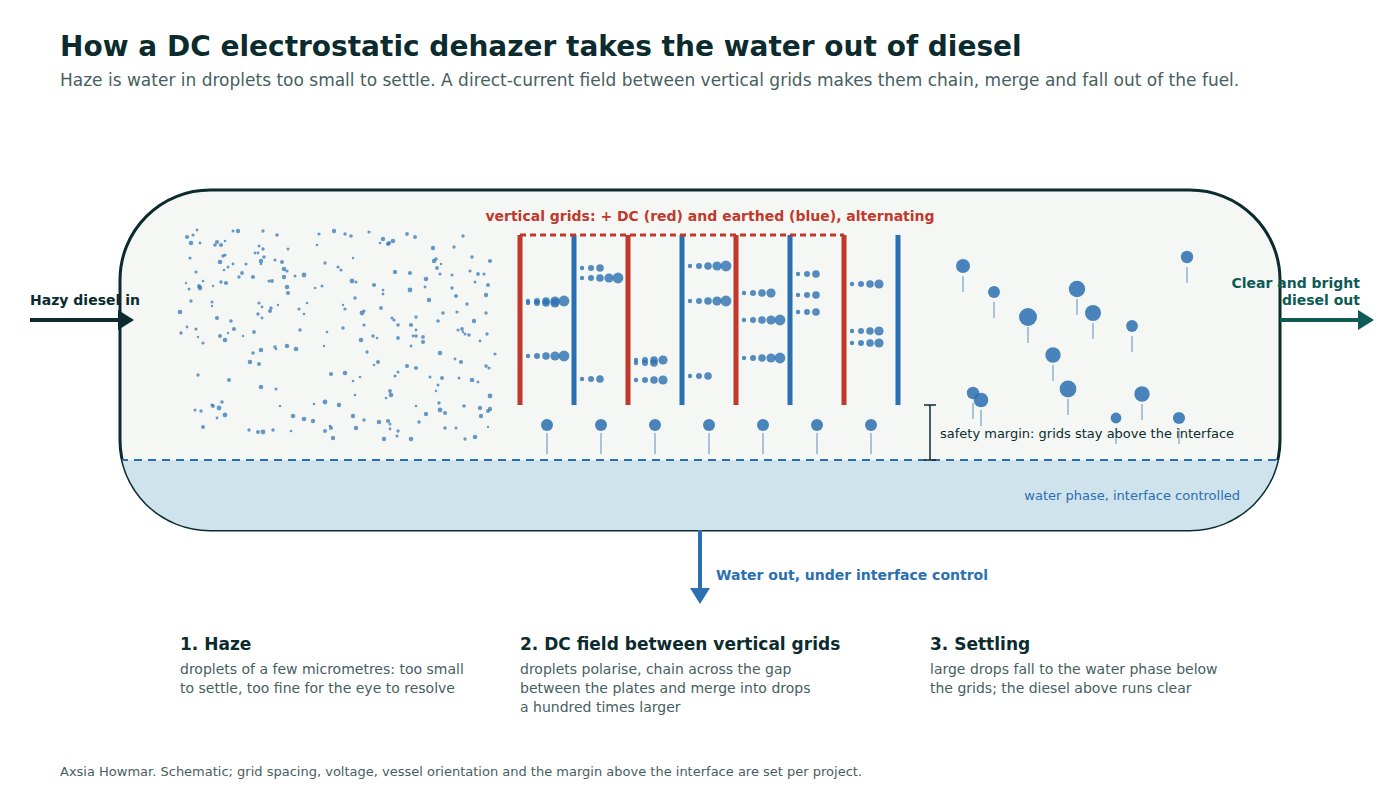
The dehazer earns its place in three positions. At the refinery diesel rundown, downstream of the hydrotreater water wash or the caustic treater, it lets the unit be pushed without sending haze to the product tank. At the import terminal, on the receipt line, it turns a cargo that would fail clear-and-bright into one that passes, before it is blended. And ahead of the FAME blending point, it takes the water out of the mineral base before the biodiesel, which holds water tightly, is added. In each case the vessel is small by the standards of a crude desalter, because the water to be removed is measured in hundreds of milligrams per kilogram rather than in per cent.
What Axsia Howmar supplies
Axsia Howmar designs and manufactures DC electrostatic dehazers for diesel, gasoil and kerosene, sized from the fuel’s throughput, water content and temperature range, and delivered with the DC power unit, the interface level control and the local panel as one package. For a refinery or terminal with an existing dehazer or prewash coalescer of any make that is no longer giving clear product, the same engineers review the unit’s operating data and report what has changed and what to do about it; most hazy-product problems are found in the voltage setting, the interface control or the inlet temperature, and are put right without new equipment. Fabrication is subcontracted to approved and audited fabricators under our supervision, and nothing on this page is a performance guarantee: the achievable water content is set for each project from the fuel and the operating conditions.
The margin on a barrel of diesel in 2026 is a once-in-a-generation number. The barrels that are lost to haze, downgraded or re-run are the cheapest ones to recover.
Sources
Figures in this article are drawn from the public sources listed below, as published on the dates shown. Where sources differ, the article uses the more conservative figure and says so.